Best AI Scribes in the UK 2026: 10 AI Clinical Scribe Platforms for NHS and Private Providers
Comparing AI scribes in the UK? This 2026 guide reviews 10 platforms for NHS GP practices, trusts and private providers across AVT Registry status, EMIS/SystmOne integration, pricing, UK evidence and workflow fit.

What is the best AI scribe in the UK in 2026?
There is no single best AI scribe for every UK healthcare organisation.
For NHS general practice, products with strong EMIS or SystmOne integration deserve particular attention. For NHS trusts, EPR integration, AVT Registry status, clinical-safety evidence and enterprise governance become more important. Private clinics may place greater weight on price, setup speed, specialty templates and portability.
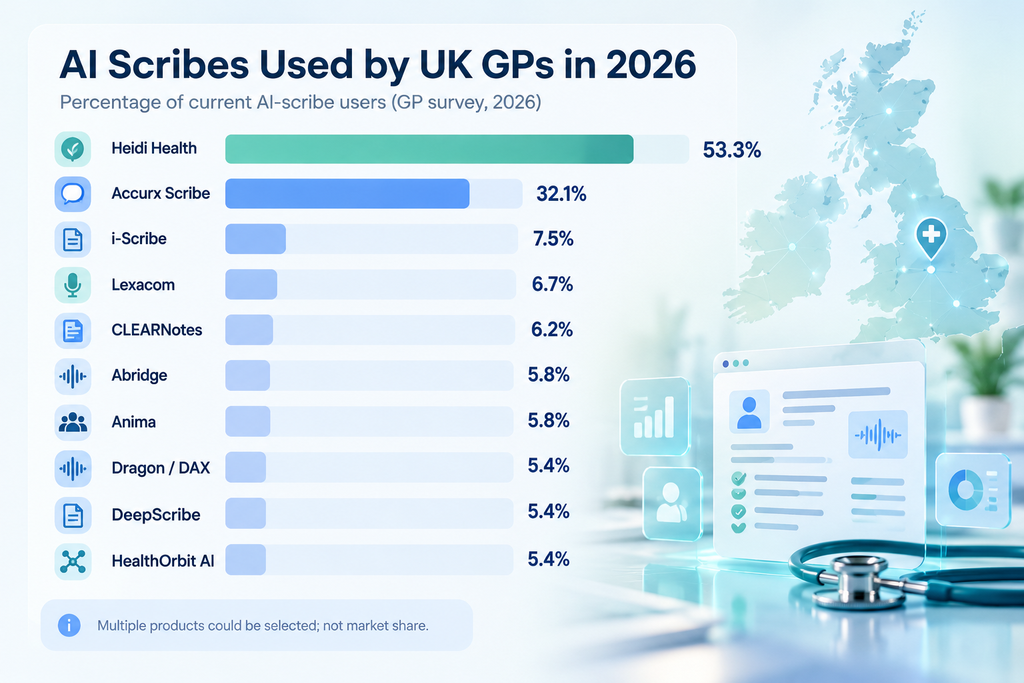
Among current AI-scribe users in one 2026 survey of UK GPs, 53.3% reported using Heidi Health and 32.1% Accurx Scribe. Multiple products could be selected, so these figures should not be interpreted as market share.
For NHS procurement, start by checking the current NHS England Ambient Voice Technology Supplier Registry, which lists 30 suppliers as of October 2026.
Key takeaways
- There is no universal “best” AI scribe. The right product depends on your healthcare setting, clinical role, EPR, governance requirements and deployment model.
- For NHS buyers, check the AVT Supplier Registry first. There are currently 30 listed suppliers, but registry inclusion is not the same as NHS endorsement.
- EMIS and SystmOne integration can materially change workflow value. Ask whether the system writes directly to the record or simply generates text for copy-and-paste.
- UK GP usage is concentrated but not standardised. A 2026 survey found Heidi and Accurx were the two most frequently reported products among current users.
- Do not compare “accuracy” percentages without methodology. Hallucinations, omissions, transcript accuracy, clinical completeness and clinician preference are different measures.
- Pricing models vary widely. Free tiers, per-clinician subscriptions, patient-list pricing and enterprise contracts all exist.
- The strongest comparison is by use case, not by feature count.
How we compared AI scribes for the UK
This comparison focuses on products with meaningful UK relevance rather than automatically including every major US AI-scribe brand.
We assessed publicly available information across:
- UK availability
- NHS AVT Supplier Registry status
- EMIS, SystmOne and EPR integration
- Clinical workflow coverage
- Clinician review and sign-off
- UK healthcare evidence
- Specialty and role coverage
- Deployment model
- Data and governance information
- Pricing transparency
- Multi-site suitability
Where information comes directly from a vendor, it should be treated as a vendor-reported capability unless supported by independent or NHS evidence.
We did not run independent head-to-head accuracy tests of the products in this article.
That distinction matters.
A product can advertise high accuracy without having been tested using the same patients, specialties, audio quality or scoring methodology as another product.
There is no single best AI scribe for every UK healthcare organisation
“Best” means different things in different settings.
An NHS GP practice may care most about:
- EMIS or SystmOne integration;
- SNOMED coding;
- patient-record write-back;
- AVT Registry status;
- low setup burden.
An NHS trust may care more about:
- Epic, Oracle Health or other EPR integration;
- central administration;
- clinical-safety governance;
- SSO;
- role-based workflows;
- deployment across specialties;
- organisation-wide monitoring.
A private clinic may instead prioritise:
- quick signup;
- monthly pricing;
- specialty templates;
- portability;
- multilingual documentation.
A physiotherapist, psychologist or dietitian may need a very different note structure from a GP or emergency physician.
The useful question is therefore not:
“Which AI scribe has the most features?”
It is:
“Which AI scribe fits our workflow, EPR, clinicians and governance requirements?”

Best AI scribes in the UK at a glance
| Platform | Best suited to | NHS AVT Registry | UK integration position | Pricing approach |
| Accurx Scribe | NHS general practice | Yes | EMIS + SystmOne | Quote based on practice/patient list |
| Optum / EMIS Scribe | EMIS practices | Verify current live registry entry | Native EMIS workflow | Not publicly standardised |
| TORTUS | NHS trusts and enterprise deployment | Yes | Epic, Oracle Health, EMIS, SystmOne and others | Enterprise / organisation quote |
| Heidi Health | Individual clinicians, practices and teams | Yes | EMIS integration available; wider EHR options vary | Free + paid + enterprise |
| Microsoft Dragon Copilot | NHS trusts and large enterprise workflows | Yes | Strong enterprise/Epic workflow coverage | Enterprise licensing |
| Anima Scribe | GP practices using integrated primary-care workflows | Yes | EMIS + SystmOne | Platform / organisation pricing |
| Lyrebird Health | Individual clinicians and organisations | Yes | EMIS, SystmOne and multiple hospital EPRs advertised | Free + £59/month Pro + organisation pricing |
| Lexacom Echo / Ambient AI | GP practices already using Lexacom | Yes under Aprobrium/Lexacom | EMIS + SystmOne | Organisation/licence based |
| HealthOrbit AI | NHS and private providers wanting UK-focused deployment | Yes | Vendor reports EMIS, SystmOne, Epic, Cerner/System C | Quote / pilot |
| EveStella by KastHunt | Private/multi-site groups wanting configurable deployment | Not currently listed | Custom EHR integration; verify current UK connectors | Beta / organisation discussion |
Important: Registry membership changes. NHS England currently lists 30 suppliers, and buyers should check the live Registry rather than relying on a static comparison article.
Which AI scribes are UK GPs actually using?
One of the most useful pieces of UK-specific evidence comes from a 2026 survey of 598 UK GPs.
Among the 240 respondents who reported current AI-scribe use:
| AI scribe | Current users reporting use |
| Heidi Health | 53.3% |
| Accurx Scribe | 32.1% |
| i-Scribe | 7.5% |
| Lexacom | 6.7% |
| CLEARNotes | 6.2% |
| Abridge | 5.8% |
| Anima | 5.8% |
| DAX / Dragon Copilot | 5.4% |
| DeepScribe | 5.4% |
| HealthOrbit AI | 5.4% |
Participants could select more than one product, so these numbers do not represent market share.
The same survey found approximately 40% of respondents were currently using AI scribes, while another 23% reported past use.
It also found that colleague recommendation was the most common reason for choosing a product.
That is worth noting for buyers.
Adoption is already happening, but much of it is being influenced by peer recommendation rather than a standard NHS-wide product choice.
Which AI scribes are on the NHS AVT Supplier Registry?
As of October 2026, NHS England lists 30 suppliers on its self-certified Ambient Voice Technology Supplier Registry.
Relevant names for this comparison include:
- Accurx
- Anima
- Aprobrium / Lexacom
- Corti
- HealthOrbit AI
- Heidi Health
- Lyrebird Health
- Microsoft Dragon
- Scribetech / Augnito
- Tandem
- TORTUS
- T-Pro
- X-On Health
The Registry is important for NHS procurement.
It should not be interpreted as:
“NHS approved.”
NHS England states that local assurance and decision-making still sit with the NHS organisation.
For the detailed assurance requirements, see our separate guide:
NHS Ambient Voice Technology Guidance 2026: What Buyers Must Check Before Choosing an AI Scribe
Which AI scribes integrate with EMIS and SystmOne?
For NHS general practice, integration can matter more than a long list of AI features.
Accurx Scribe
Accurx Scribe can save reviewed notes into EMIS and SystmOne through Accurx Desktop.
Certain observations, including blood pressure, temperature and peak-flow measurements, can also be saved as SNOMED codes.
Anima
Anima Scribe can generate a structured consultation note, allow the clinician to review suggested codes and save the result directly into EMIS or SystmOne.
Heidi
Heidi now documents an EMIS integration that pulls appointments into Heidi and allows generated notes to be pushed back to the patient’s EMIS record. The integration runs through Hero Health and requires a qualifying plan.
Lexacom
Lexacom’s 2026 Ambient AI update can retrieve patient details from EMIS Web or SystmOne and insert generated text directly into an open consultation as editable text.
TORTUS
TORTUS reports direct Epic and Oracle Health integration, with EMIS, SystmOne and Access integrations delivered through its SDK and partners.
HealthOrbit AI
HealthOrbit publicly reports integrations with SystmOne, EMIS, Epic, Cerner, System C and other EPRs. These are vendor-reported capabilities and should be demonstrated during procurement.
What buyers should check
Do not stop at:
“Does it integrate with EMIS?”
Ask:
- Does it identify the patient automatically?
- Does it pull appointment context?
- Does it write directly to the correct encounter?
- Does it save structured codes or only text?
- Does the clinician review before write-back?
- Is copy-and-paste required anywhere?
- What happens when integration fails?
Two products can both say “EMIS integration” while creating very different workflows.
1. Accurx Scribe — strong fit for NHS general practice
Best for: GP practices already working heavily in Accurx, EMIS or SystmOne.
Accurx Scribe is powered by Tandem and works across Accurx Desktop, Web and Mobile.
It records or transcribes a consultation, generates structured documentation and can create additional documents such as referral or patient letters.
For practices using EMIS or SystmOne with Accurx Desktop, reviewed notes can be saved directly into the patient record.
Strong points
- EMIS and SystmOne write-back
- SNOMED coding for supported observations
- Works within a familiar UK primary-care platform
- Referral and patient-document generation
- NHS AVT Registry listed
Things to check
- pricing scales with patient-list size;
- exact functionality depends on setting;
- secondary-care deployments require organisation-level discussion.
Accurx states that GP practices receive a trial and then quote-based pricing linked to patient-list size.
Probably not ideal for
Organisations primarily looking for an EPR-agnostic enterprise ambient platform rather than the wider Accurx ecosystem.
2. Optum / EMIS Scribe — strong fit for EMIS-native workflows
Best for: organisations that want ambient documentation embedded deeply into the EMIS clinical record.
Optum has been developing EMIS Scribe as a directly integrated ambient-scribing capability for EMIS Web and EMIS-X.
The company describes the product as generating structured documentation and contextual SNOMED-CT coding within the existing clinical workflow.
Strong points
- native EMIS environment;
- structured record emphasis;
- contextual coding;
- designed around primary-care data integrity.
Things to check
Optum announced earlier in 2026 that it had been accepted onto the AVT Registry.
However, because supplier names and registry entries can change, buyers should verify the current live NHS Registry entry and contracting entity before procurement rather than relying on an older announcement.
Probably not ideal for
Practices primarily using SystmOne or organisations needing a platform independent of the EMIS ecosystem.
3. TORTUS — strong fit for NHS trusts and evidence-led procurement
Best for: NHS trusts, secondary care and organisations prioritising UK deployment evidence.
TORTUS has one of the most visible bodies of UK NHS deployment evidence in the category.
The product has been evaluated across multiple NHS clinical settings and is deployed across primary, secondary and emergency-care workflows.
TORTUS reports:
- Epic integration;
- Oracle Health integration;
- EMIS and SystmOne routes through partners;
- structured notes;
- letters;
- code suggestions;
- clinician approval before EHR filing.
Its NHS evaluation included more than 17,000 patient encounters across nine sites and reported a 23.5% increase in direct patient interaction time and 13.4% higher A&E patient throughput per shift.
Strong points
- substantial UK NHS evidence;
- secondary-care focus;
- several major NHS EPR integrations;
- clinician approval before filing;
- UKCA Class IIa certification reported in 2026.
Things to check
- exact integration available at your site;
- deployment and implementation requirements;
- commercial terms.
Probably not ideal for
A solo private clinician simply looking for a low-cost, self-service note generator.
4. Heidi Health — strong fit for individual clinicians and flexible teams
Best for: clinicians wanting a low-friction product that can scale from individual use to practice or enterprise deployment.
Heidi combines ambient documentation with configurable templates, generated documents, evidence tools and multiple deployment options.
Its UK product currently advertises transcription across 110+ languages, custom documentation and EHR connectivity.
Strong points
- permanent free option;
- low barrier to individual adoption;
- configurable templates;
- EMIS integration available;
- practice and enterprise tiers;
- NHS AVT Registry listed.
Heidi’s current UK pricing structure includes Free, Clinician and Practice plans, with enterprise arrangements available separately.
Things to check
- EHR integration availability varies by system and plan;
- governance needs differ between individual and organisation-wide use;
- integration add-ons may require paid tiers.
Probably not ideal for
An NHS organisation that assumes individual clinician adoption is equivalent to centrally governed enterprise deployment.
5. Microsoft Dragon Copilot — strong fit for large trusts and role-specific enterprise workflows
Best for: healthcare organisations already working extensively with Microsoft, Dragon or Epic infrastructure.
Dragon Copilot combines ambient documentation with the Dragon clinical-documentation ecosystem.
Microsoft now provides workflows specifically designed for physicians and nurses, rather than treating every clinician as the same user.
Its nursing workflow can capture care within Epic Rover and turn observations into draft flowsheet entries for review and filing.
Strong points
- enterprise healthcare infrastructure;
- physician and nursing workflows;
- Epic Rover ambient documentation;
- desktop, web and mobile capabilities;
- NHS deployment examples.
Things to check
- functionality varies by organisation and configuration;
- enterprise implementation requirements;
- licensing and integration costs.
Probably not ideal for
Small independent practices that need a simple self-service scribe with transparent monthly pricing.
6. Anima Scribe — strong fit for primary care teams already using Anima
Best for: GP practices that want ambient documentation integrated with wider triage and primary-care workflows.
Anima’s Scribe records the consultation, generates structured notes, suggests codes and can save reviewed content directly into EMIS or SystmOne.
It can also generate referral documents and patient follow-up messages from the same consultation.
Strong points
- direct EMIS/SystmOne workflow;
- coding suggestions;
- referral and follow-up generation;
- wider primary-care workflow platform;
- Registry listed.
Things to check
- greatest value may come when using the wider Anima platform;
- evaluate whether broader platform adoption is desirable for your organisation.
Probably not ideal for
An organisation looking only for an independent scribing layer with no interest in a wider primary-care platform.
7. Lyrebird Health — strong fit for clinicians wanting transparent individual pricing
Best for: individual clinicians and organisations wanting a mature ambient product with a clearly published individual pricing option.
Lyrebird’s UK platform advertises integrations including:
- EMIS;
- TPP SystmOne;
- Oracle Cerner;
- Epic;
- Meditech;
- Nervecentre.
The platform extends beyond consultation notes into referral letters, certificates, care plans and follow-up workflows.
Strong points
- NHS Registry listed;
- broad advertised UK EPR connectivity;
- free entry option;
- transparent individual pricing;
- wider workflow functions.
As of August 2026, Lyrebird lists its UK Pro plan at £59 per month, or £480 annually, with organisation pricing available separately.
Things to check
- exact integration depth at your site;
- organisation pricing;
- which workflow features are available in the UK configuration.
Probably not ideal for
Buyers who assume every advertised EPR connection has identical depth without testing the specific workflow.
8. Lexacom Echo / Ambient AI — strong fit for existing Lexacom users
Best for: practices already using Lexacom for clinical voice and documentation workflows.
Lexacom’s 2026 Ambient AI release supports patient context from EMIS and SystmOne, configurable templates and direct insertion into the open consultation.
Strong points
- established UK clinical-documentation presence;
- EMIS and SystmOne connectivity;
- editable write-back;
- templates and saved refinements;
- Registry listed as Aprobrium / Lexacom.
Things to check
- licence structure;
- workflow differences between API and direct text insertion;
- organisation-wide configuration.
Probably not ideal for
Clinicians looking primarily for a standalone free mobile scribe.
9. HealthOrbit AI — strong fit for UK-focused integration requirements
Best for: NHS and private organisations wanting a UK-focused product with several advertised clinical-system integrations.
HealthOrbit reports direct integration with:
- SystmOne;
- EMIS;
- Epic;
- Cerner;
- System C;
- HL7/FHIR integrations.
It also states that clinicians review and sign off generated notes before they enter the patient record.
Strong points
- NHS Registry listed;
- UK-focused product positioning;
- broad vendor-reported EPR integration;
- clinician review before filing;
- UK data-processing claims.
Things to check
Most of these capabilities are currently documented by the vendor itself.
During procurement, ask to see the exact integration working in your own EPR and clinical setting.
Probably not ideal for
A buyer unwilling to validate vendor-reported integrations during a real pilot.
10. EveStella by KastHunt — strong fit for configurable multi-role workflows
Best for: private healthcare groups, multi-site providers and health-tech organisations that want greater control over workflow and deployment architecture.
Disclosure: KastHunt develops EveStella.
EveStella is KastHunt’s ambient AI clinical-documentation product.
The current product is designed around a broader workflow than consultation capture alone:
- patient intake;
- front-desk interactions;
- nursing triage;
- consultation documentation;
- structured, review-ready notes.
The product is designed to run in the client’s environment, and clinician sign-off remains required for generated notes.
Strong points
- configurable by role and workflow;
- structured notes;
- clinician sign-off;
- deployment inside the organisation’s environment;
- multi-role workflow rather than physician-only documentation.
Current limitations
- EveStella is not currently listed on the NHS AVT Supplier Registry;
- NHS-specific assurance status should not be implied until completed;
- EMIS and SystmOne integrations should be described only when verified and live;
- there is no published independent UK comparative evidence yet.
Best fit today
Private providers, multi-site healthcare organisations and health-tech partners evaluating configurable clinical-documentation workflows.
For NHS procurement, current Registry and assurance status should be checked before considering deployment.
Best AI scribes by UK healthcare setting
| Your setting | Products worth shortlisting first |
| NHS GP using EMIS/SystmOne | Accurx, Anima, Lexacom, Heidi, TORTUS |
| EMIS-first practice | Optum / EMIS Scribe, Accurx, Anima |
| NHS trust / secondary care | TORTUS, Dragon Copilot, Heidi, HealthOrbit |
| Individual clinician / locum | Heidi, Lyrebird |
| Private clinic | Heidi, Lyrebird, HealthOrbit, EveStella |
| Allied health | Heidi, Lyrebird and other products with appropriate specialty templates |
| Multi-site group | TORTUS, Dragon Copilot, Heidi enterprise, EveStella |
| Organisation prioritising own-environment deployment | EveStella — subject to integration and assurance requirements |
This is a shortlisting guide, not a ranking.
Your final choice still depends on workflow, EPR, role, governance and implementation requirements.
Which AI scribe is the most accurate?
There is no trustworthy universal answer.
“Accuracy” can mean:
- speech-transcription accuracy;
- completeness;
- hallucination rate;
- omission rate;
- medication accuracy;
- semantic agreement;
- note quality;
- clinician preference;
- edit burden.
A vendor reporting:
“98% accurate”
may be measuring something completely different from another vendor reporting:
“95% accurate.”
Unless the products were tested on the same consultations, using the same scoring framework, the numbers should not be treated as directly comparable.
A stronger buyer question is:
How often does the scribe omit, add or misrepresent clinically important information in our own consultations?
That should be measured during a pilot.
Which AI scribes go beyond note generation?
The category is moving beyond simple transcription.
Examples now include:
- referral letters;
- patient letters;
- clinical coding;
- tasks;
- care plans;
- nursing documentation;
- follow-up workflows;
- meeting documentation;
- clinical information retrieval.
Accurx can generate referral and patient letters from the encounter.
Anima can generate referrals and follow-up communications alongside the consultation note.
Dragon Copilot now extends ambient documentation into nursing flowsheets and nurse-specific documentation workflows.
Lyrebird advertises workflows extending into care plans, recalls and team tasks.
This means buyers should distinguish:
AI scribe
from:
broader clinical workflow platform.
More functionality is not automatically better.
It matters only if the extra functions solve a workflow your organisation actually has.
How much do AI scribes cost in the UK?
Pricing is difficult to compare because suppliers use different commercial models.
| Pricing model | Common buyer |
| Free / freemium | Individual clinicians |
| Per clinician/month | Private practices and smaller teams |
| Patient-list based | NHS general practice |
| Organisation licence | Groups and larger providers |
| Enterprise quote | NHS trusts and health systems |
Examples:
- Heidi: permanent free option plus paid individual, practice and enterprise plans.
- Lyrebird: free Lite plan; UK Pro pricing currently listed at £59/month or £480/year.
- Accurx: quote-based pricing for GP practices based on patient-list size after trial.
- Enterprise platforms: typically require organisation-specific quotations.
Do not choose based on monthly subscription price alone.
Compare:
total cost ÷ actual active users ÷ useful clinical encounters
and include implementation, integration, training and support costs.
Which AI scribes support multilingual consultations?
Language-count claims need careful interpretation.
Ask whether the product supports:
- speech recognition in the language;
- mixed-language consultations;
- translated output;
- clinical terminology;
- speaker separation;
- note generation in a different language from the consultation.
For example, Heidi currently advertises transcription in more than 110 languages.
But:
“Supports 110 languages” does not automatically mean identical clinical performance across 110 languages.
Test the languages and accents your patients actually use.
Are AI scribes only for doctors?
No.
Ambient documentation is expanding into:
- nursing;
- allied health;
- mental health;
- pharmacy;
- dentistry;
- physiotherapy;
- dietetics;
- occupational therapy.
Microsoft’s current Dragon Copilot nursing workflow shows how different role requirements can become: it can capture nursing observations and draft flowsheet entries within Epic Rover.
A nursing workflow is not simply a physician SOAP note with a different title.
The same applies to allied health.
Test each profession separately.
How should a UK healthcare organisation shortlist AI scribes?
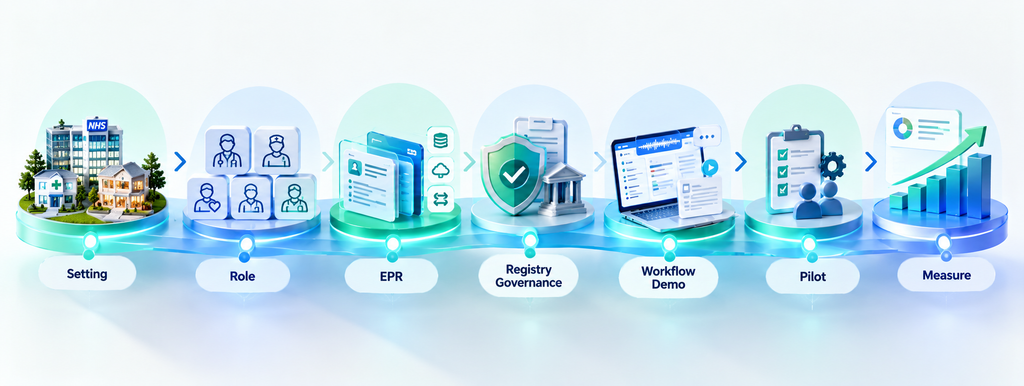
Use this order.
1. Define the setting
NHS GP, NHS trust, private clinic, community provider or multi-site group?
2. Define the users
Doctors only?
Or nurses, AHPs, administrative staff and other roles?
3. Map the existing systems
EMIS?
SystmOne?
Epic?
Oracle Health?
Multiple EPRs?
4. Check the AVT Registry where relevant
For NHS deployment, start with the current NHS England Registry.
5. Check governance and data requirements
Clinical safety, information governance, hosting, subprocessors and clinician-review requirements.
6. Test the actual integration
Don’t accept an EHR logo as evidence.
Watch the entire workflow.
7. Test real consultations
Include different:
- specialties;
- accents;
- visit lengths;
- multiple problems;
- clinical terminology.
8. Measure review burden
The note is useful only if the clinician can safely review and approve it efficiently.
9. Compare commercial models
Use realistic utilisation rather than headline monthly price.
10. Pilot before scaling
The product should prove itself inside the workflow where it will actually be used.
Ask every AI-scribe vendor to demonstrate these five workflows
1. Routine consultation
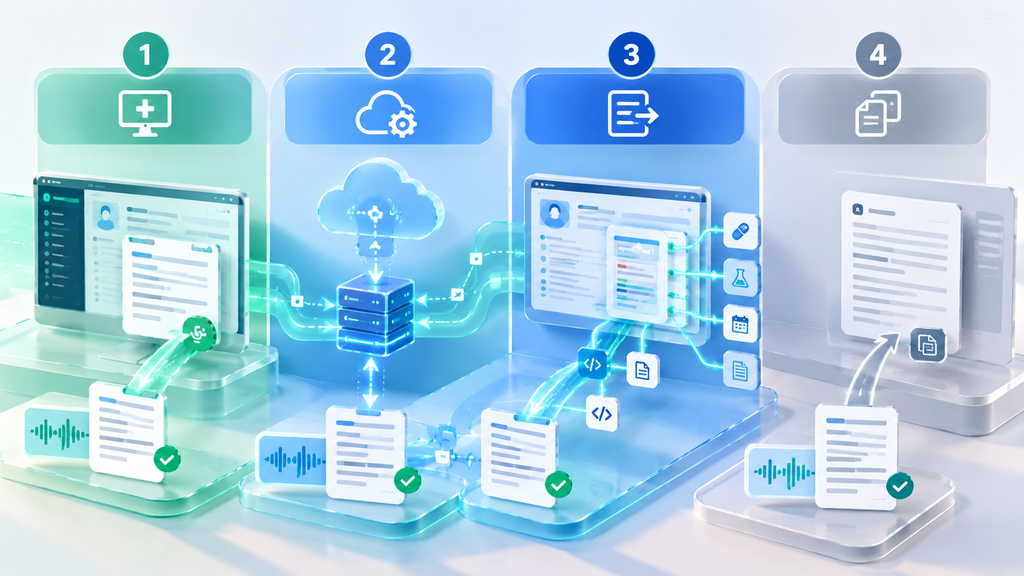
Record → generate → review → sign → save.
2. Multi-problem consultation
Check whether the system correctly separates multiple conditions and plans.
3. Referral workflow
Generate the consultation note and referral document from the same encounter.
4. Coding workflow
Show how clinical codes are suggested, reviewed, changed and saved.
5. EPR write-back
Watch the final note reach the correct patient and correct encounter.
For NHS use, add one more:
6. Patient declines AVT
Show the alternative documentation workflow.
A polished demonstration of note generation alone is not enough.
Red flags when comparing AI scribes
Be cautious if a supplier:
- describes itself as “NHS approved” without explaining what that means;
- gives an accuracy percentage without methodology;
- cannot explain its hallucination or omission testing;
- cannot clearly state where patient data is processed;
- does not disclose relevant subprocessors;
- advertises “EMIS integration” but relies on manual copy-and-paste;
- cannot demonstrate clinician review before filing;
- cannot explain what happens when the integration fails;
- provides no evidence by specialty or role;
- cannot explain its pricing model;
- cannot show how significant model changes are governed;
- relies only on vendor testimonials as evidence.
What should you measure during an AI-scribe pilot?
Do not measure only satisfaction.
Track:
| Area | Suggested measure |
| Documentation | Time to completed/signed note |
| Review burden | Editing and review time |
| Quality | Omissions and unsupported additions |
| Clinical safety | Clinically significant corrections |
| Integration | Successful EPR write-back |
| Adoption | Percentage of eligible consultations using the scribe |
| Workload | After-hours documentation |
| Patient experience | Objections / feedback |
| Reliability | Failed recordings and outages |
| Commercial | Cost per active clinician / encounter |
Then compare the results with your pre-pilot baseline.
How KastHunt approaches AI-scribe selection
KastHunt does not start with a vendor feature list.
The starting point is:
role → workflow → EPR → governance → deployment → pilot → measurement
That means asking:
- Who will use the system?
- Where in the clinical day will they use it?
- What documentation should it create?
- Where must that documentation go?
- What review is required?
- What data boundary applies?
- What should improve if the pilot works?
EveStella follows the same review-first approach: consultation information is turned into structured, review-ready documentation, with clinician sign-off remaining in the workflow.
The goal should not be to find the AI scribe with the longest feature list.
It should be to find the one that removes useful work without introducing a worse workflow somewhere else.
Choosing an AI scribe for your organisation?
The shortlist is only the beginning.
KastHunt helps healthcare organisations map their documentation workflow, integration requirements and pilot measures before committing to wider AI deployment.
Frequently asked questions
What is the best AI scribe in the UK?
There is no single best product for every UK healthcare organisation. NHS GP practices should prioritise EMIS/SystmOne integration and NHS assurance, while hospitals may need enterprise governance and EPR integration. Private clinics may put more weight on cost, portability and specialty fit.
What AI scribe do UK GPs use most?
In one 2026 survey of current UK GP AI-scribe users, 53.3% reported Heidi Health and 32.1% Accurx Scribe. Respondents could select multiple products, so the figures are not market-share estimates.
Which AI scribes are on the NHS AVT Supplier Registry?
NHS England currently lists 30 suppliers, including Accurx, Anima, Lexacom, HealthOrbit AI, Heidi Health, Lyrebird Health, Microsoft Dragon, Tandem and TORTUS. The list changes, so check the live Registry before procurement.
Which AI scribes integrate with EMIS and SystmOne?
Accurx and Anima document direct workflows for both systems. Lexacom also supports EMIS and SystmOne workflows, while TORTUS and other vendors provide integrations through direct or partner routes. Integration depth should always be demonstrated rather than inferred from an EHR logo.
Is Heidi available free in the UK?
Yes. Heidi currently offers a permanent free plan alongside paid clinician, practice and enterprise options. Some integrations and advanced functionality require higher plans.
Which AI scribe is best for NHS hospitals?
Products worth evaluating include TORTUS and Microsoft Dragon Copilot, alongside other current Registry suppliers appropriate to the trust’s EPR and workflows. The final choice should depend on integration, governance, specialty fit and local evaluation rather than a universal ranking.
Which AI scribe is best for a private UK clinic?
Private clinics may consider products such as Heidi, Lyrebird, HealthOrbit and other products that fit their PMS/EPR, specialty, hosting and commercial requirements. Multi-site groups should also evaluate central governance and site-level configuration.
Are AI scribes accurate?
They can produce useful documentation, but there is no single comparable accuracy percentage across the market. Buyers should measure omissions, hallucinations, clinically significant corrections and review burden using their own workflows.
Does EveStella integrate with NHS GP systems?
EveStella’s current public positioning focuses on configurable clinical workflows, structured review-ready notes and deployment within the organisation’s environment. EMIS or SystmOne integration should only be claimed once the specific connector is verified as live. EveStella is not currently on the NHS AVT Supplier Registry.
Related reading
- NHS Ambient Voice Technology Guidance 2026: What Buyers Must Check
- How to Choose an AI Clinical Scribe for Multi-Site Providers
- Best AI Clinical Scribe Platforms in 2026: 15 Compared
- How Accurate Are AI Medical Scribes? What the Studies Actually Measured
- Do AI Scribes Reduce Clinician Burnout? What the Evidence Says About Workload, Burnout and Retention
Sources
Accurx — Scribe product and integration documentation — EMIS/SystmOne workflow and pricing model.
Optum / EMIS — EMIS Scribe documentation — integrated primary-care scribing and coding.
Great Ormond Street Hospital / TORTUS — NHS AVT deployment and evaluation evidence.
Microsoft — Dragon Copilot — physician and nursing workflows.
Anima — Scribe product documentation — EMIS/SystmOne integration and consultation workflow.
Heidi Health — UK product, pricing and EMIS documentation — free/paid models and integration.
Lyrebird Health — UK platform and pricing documentation — EPR coverage and UK pricing.
Lexacom — 2026 Ambient AI release documentation — EMIS/SystmOne write-back.
HealthOrbit AI — UK product documentation — vendor-reported integration and deployment claims.
KastHunt — EveStella PoC page — current product capabilities and deployment positioning.