Do AI Scribes Reduce Clinician Burnout? What the Evidence Says About Workload, Burnout and Retention
AI scribes can reduce documentation burden and may reduce clinician burnout, but the outcomes should not be treated as the same thing. Studies generally show modest reductions in documentation time and cognitive workload, while burnout findings are positive but mixed. Evidence that AI scribes improve long-term clinician retention remains early.
Do AI scribes reduce clinician burnout? Probably, but not as simply as many articles suggest.
AI scribes often reduce documentation time by modest amounts. In the largest controlled study reviewed here, adopters spent about 16 fewer minutes on documentation per eight hours of scheduled patient time. In a separate six-health-system study, burnout fell from 51.9% to 38.8% after 30 days.
However, another 2026 study found that note time decreased while burnout did not change significantly.
The evidence is therefore strongest for documentation relief and cognitive workload, growing but mixed for burnout, and still early for long-term clinician retention.
Key takeaways
- Time savings are real but usually modest. Stronger controlled studies generally report minutes saved rather than hours per clinician per day.
- Less documentation does not guarantee less burnout. Several studies report improvement, while others do not.
- Retention evidence is still early. Current evidence relies heavily on intention-to-stay surveys and vendor-reported turnover outcomes.
- Outpatient productivity gains are generally small in the strongest evidence. Some emergency-care evaluations have reported larger capacity gains.
- Some work moves rather than disappears. Typing can become review, correction and sign-off work.
- Who uses the scribe matters. Primary-care clinicians, frequent users and clinicians with higher baseline documentation burden often appear to benefit more.
What does the evidence actually show about AI scribes and clinician workload?
Articles often use workload, documentation burden, cognitive load and burnout as though they mean the same thing.
They do not.
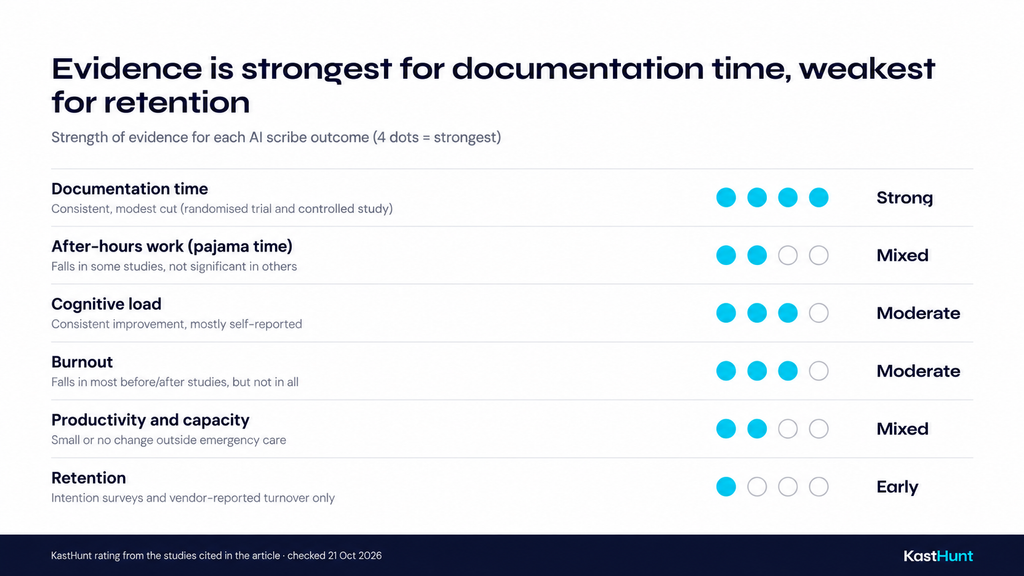
| Outcome | How it is measured | What current studies suggest | Evidence strength |
| Documentation time | Minutes spent in notes using EHR audit logs | Consistent, generally modest reduction | Stronger |
| After-hours work | EHR use outside scheduled hours | Improves in some studies; not significant in others | Mixed |
| Cognitive load | Clinician surveys/task-load measures | Frequently improves | Moderate |
| Burnout | Validated or single-item burnout measures | Improvement in several studies, but not all | Moderate |
| Productivity | Visits, cycle time, revenue | Usually small or no change in outpatient settings | Mixed |
| Retention | Turnover or intention to leave | Early positive signals | Early |
Two distinctions are particularly important:
Reduced documentation time does not automatically mean reduced burnout.
And:
Reduced burnout has not yet been shown conclusively to reduce actual clinician turnover.
The main AI-scribe studies at a glance
| Study | Design / setting | Workload result | Burnout result | Productivity / retention |
| UCLA / NEJM AI | Randomised, 238 outpatient physicians | Nabla reduced time in notes by 9.5%; DAX change was not significant | Survey measures suggested improvement | Not measured |
| Five academic centres / JAMA, 2026 | 8,581 clinicians; 1,809 adopters | 16 fewer documentation minutes per 8 scheduled patient hours | Not measured | +0.49 visits/week |
| Six US health systems / JAMA Network Open | 263 physicians and APPs | Lower after-hours documentation and cognitive task load | 51.9% → 38.8% | Not measured |
| MGB + Emory | Before/after evaluation | — | MGB burnout prevalence 21.2 percentage points lower; Emory documentation-related well-being 30.7 percentage points higher | Not measured |
| Providence | 1,547 users, longitudinal EHR data | Note time fell early; after-hours work declined more gradually | Not measured | Adoption remained limited |
| Hawaii Pacific Health / JMIR | 79 providers | High users: 21% less note time | 59.5% → 50.6%, not statistically significant | Not measured |
| Penn Medicine | 46 clinicians | 20.4% less note time; 30% less after-hours work | Not measured | Not measured |
| Canada Health Infoway | 12,019 clinicians | 1.11 hours/week saved during work plus almost an hour after hours | Cognitive-load improvement reported | >80% reported better engagement |
| Singapore | 9 clinicians, 169 consultations | Documentation 15% shorter | Not measured | Total visit cycle time unchanged |
| Netherlands | 12 GPs, 535 patients | 42.7 seconds less documentation/consultation | Lower perceived workload | Total consultation time unchanged |
| NHS/GOSH/TORTUS evaluation | 9 sites, 17,000+ patients | 23.5% more direct patient interaction time | Not measured | 13.4% more patients/A&E shift |
| Cleveland Clinic / Ambience | 4,000+ clinicians | — | 97% satisfaction among established users | 60% said it increased likelihood of staying |
Important: these studies are not directly interchangeable. Some are randomised trials, others are observational studies, programme evaluations, health-system reports or vendor-supported case studies.
How much documentation time do AI scribes actually save?
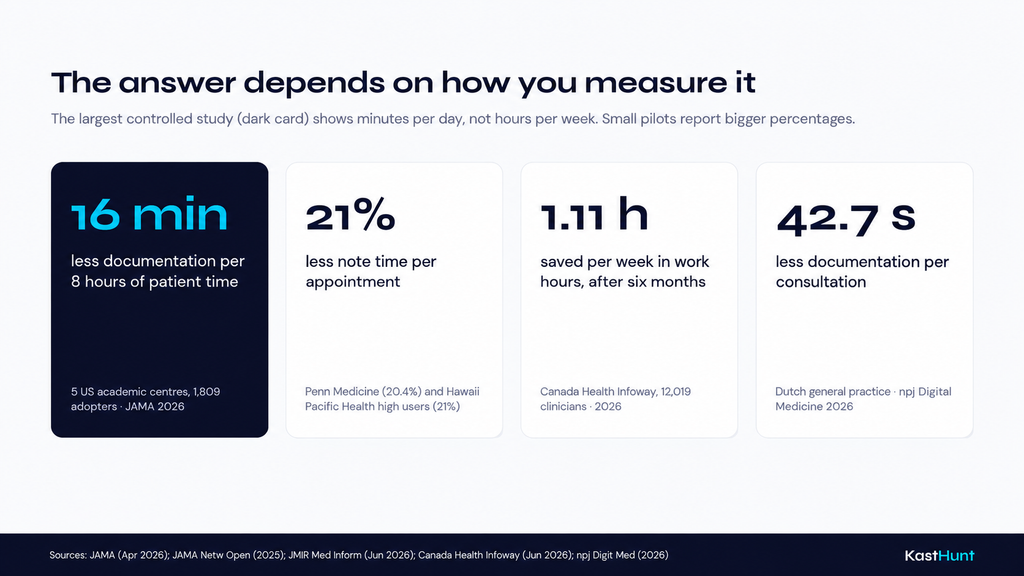
There is no single number.
That variation is part of the finding.
Examples include:
- 16 fewer documentation minutes per eight scheduled patient hours in the large five-centre JAMA study.
- 20.4% less note time per appointment in a Penn Medicine pilot.
- 21% less note time among high users at Hawaii Pacific Health.
- 1.11 hours per week during work hours in Canada Health Infoway’s national programme.
- 15% less documentation time in a Singapore time-and-motion study.
- 42.7 seconds less per consultation in Dutch general practice.
- In UCLA’s randomised trial, Nabla reduced time in notes by 9.5%, while DAX Copilot did not show a statistically significant reduction compared with control.
The fair interpretation is:
AI scribes often save documentation time, but the amount varies substantially by product, clinician, specialty, workflow and frequency of use.
Do AI scribes reduce after-hours charting or “pajama time”?
Sometimes.
“Pajama time”, also called work outside of work (WOW), refers to EHR activity after scheduled clinical hours.
Evidence is mixed.
Penn Medicine reported 30% less after-hours work per day, while Canada’s national programme reported almost an hour of after-hours time saved per week.
Providence also found that after-hours EHR time decreased gradually over longer use.
However, the large five-centre JAMA study found a 3.1-minute reduction that was not statistically significant. Hawaii Pacific Health similarly reported a 13% reduction in measured pajama time that did not reach statistical significance.
This suggests that after-hours benefits may develop differently from immediate reductions in note-writing time.
Do AI scribes reduce cognitive workload, not just typing time?
This may be one of the more important benefits.
The six-health-system study reported lower cognitive task load alongside lower burnout.
Canada’s national programme reported that almost 80% of participating clinicians experienced lower cognitive load.
Dutch GPs also reported lower workload even though total consultation time did not change significantly.
That helps explain an important pattern:
A clinician can experience meaningful workload relief even when EHR logs show only modest time savings.
Less simultaneous typing, fewer unfinished notes and more attention during the consultation can affect mental workload in ways that raw time measurements do not fully capture.
Does less documentation time actually reduce clinician burnout?
Often, but not always.
Evidence showing improvement
The six-health-system study reported burnout falling from 51.9% to 38.8% after 30 days.
Mass General Brigham reported burnout prevalence 21.2 percentage points lower at 84 days.
Emory reported documentation-related well-being 30.7 percentage points higher at 60 days.
The UCLA randomised trial also reported favourable signals for burnout and work exhaustion, although the authors noted that larger studies are needed.
PHTI has concluded that ambient scribes appear likely to improve clinician burnout, while also highlighting remaining evidence gaps.
Evidence showing no statistically significant improvement
At Hawaii Pacific Health, high users reduced note time by 21%, while burnout changed from 59.5% to 50.6%, which was not statistically significant.
Why can these outcomes differ?
Because burnout has many causes beyond documentation:
- staffing
- inbox burden
- scheduling
- leadership
- administrative requirements
- workload intensity
- compensation
- work-life boundaries
Time saved on documentation can also be absorbed by additional appointments or administrative work.
So:
Documentation relief can contribute to lower burnout without being sufficient to solve burnout on its own.
Are AI scribes reducing work or moving it from writing to reviewing?
Both.
Typing may decrease, but AI documentation introduces another workflow:
Generate → review → correct → approve → audit
That work matters.
It is also a clinical-safety requirement.
AI-generated notes can contain:
- omissions
- hallucinations
- incorrect attribution
- wrong numbers or units
- medication inaccuracies
- template or formatting problems
Ontario’s assessment of 20 AI-scribe products found incorrect medical information in every product tested, according to the provincial evaluation cited in the source material.
A fair pilot therefore needs to count the new work AI creates:
- reviewing every draft
- correcting errors
- filling omissions
- adjusting style
- verifying suggested codes
- managing patient consent
- redoing failed recordings
- maintaining specialty templates
- handling governance and audit
Review time should be measured against the documentation time saved, not treated as invisible overhead.
Which clinicians benefit most from AI scribes?
Benefits are not distributed evenly.
The large five-centre JAMA study found:
- Primary care clinicians: 26.9 fewer documentation minutes per eight patient hours.
- All adopters: 16 fewer minutes.
- Frequent users: 27.3 fewer documentation minutes and about one additional visit per week.
- Female clinicians: 19.9 fewer documentation minutes and 6.2 fewer after-hours minutes.
- Advanced practice clinicians and residents were also among groups showing meaningful changes.
Other evaluations similarly suggest larger gains among frequent users.
Evidence for nurses, allied health professionals and front-desk staff is much thinner because most published research still focuses on physicians and advanced practice clinicians.
That evidence gap matters as vendors expand ambient AI beyond the doctor’s consultation.
Do AI scribes increase productivity or patient capacity?
Usually only modestly in outpatient settings, based on current stronger evidence.
The five-centre JAMA study reported 0.49 additional visits per week per adopter, or roughly one extra patient every two weeks.
Frequent users gained about one additional visit per week.
In Singapore, documentation time decreased by 15%, but total patient cycle time did not change significantly.
The Dutch study produced a similar pattern: documentation became faster without a significant reduction in total consultation time.
Emergency-care evaluations have shown larger gains.
The NHS/GOSH/TORTUS evaluation reported 13.4% more patients per A&E shift.
PHTI has also noted that the broader financial impact of ambient scribes remains uncertain.
Therefore:
Time saved does not automatically become additional clinical capacity or revenue.
What happens to the time clinicians save?
This question may matter more than the headline number of minutes saved.
| Where time may go | What current evidence suggests |
| More patient attention | Singapore reported eye contact rising from 69.6% to 77.1%; NHS evaluation reported more direct interaction time |
| Additional appointments | Small increase in large outpatient study; larger gains reported in some emergency settings |
| Earlier chart completion | Seen in several implementation studies |
| Less after-hours work | Improvement in some studies; mixed overall |
| Other administrative work | Rarely measured |
The Singapore study is particularly useful because documentation time decreased while total consultation time remained similar.
That suggests ambient AI may sometimes reallocate attention rather than simply increase throughput.
If an organisation saves 20 minutes per clinician per day but immediately fills those minutes with more appointments or additional administrative work, burnout may not improve proportionally.
What happens after the time is saved is partly an organisational decision, not simply a software outcome.
Does reducing documentation burden improve clinician retention?
The signals are promising, but retention has the least mature evidence of the major outcomes reviewed here.
1. Intention to stay
At Cleveland Clinic, 60% of established users reportedly said the ambient scribe increased their likelihood of remaining in practice.
This measures intention, not actual turnover.
2. Actual turnover
John Muir Health reported a 44% reduction in primary-care-provider turnover alongside a reported reduction in time spent in notes.
However, this is a vendor-reported customer outcome rather than a controlled retention study, so other organisational changes may also have contributed.
3. Continued use of the AI tool
Some organisations report very high continued use among clinicians who adopt ambient AI.
But product retention is not the same as job retention.
The evidence-safe conclusion is:
No controlled study currently establishes that AI scribes reduce actual long-term clinician turnover.
Healthcare organisations should therefore measure actual turnover by role and site rather than relying only on satisfaction or intention-to-stay surveys.
Why do AI-scribe studies report different results?
Because they often measure different things in different populations.
Before comparing two figures, check:
Study design
A randomised trial provides stronger causal evidence than a simple before-and-after survey.
Measurement method
EHR audit logs measure behaviour.
Surveys measure clinician experience.
Both are useful, but they answer different questions.
Participant selection
Many pilots are voluntary.
Clinicians who choose to participate may differ from those who do not.
Survey response
Low response rates can distort burnout or satisfaction results.
Study length
A 30-day pilot can capture early enthusiasm but may not show whether effects persist.
Product
Different AI scribes can perform differently even within the same study.
Usage intensity
Frequent users often experience larger changes than occasional users.
Specialty and baseline burden
Clinicians with greater documentation burden may have more opportunity to benefit.
Source of evidence
Independent research, health-system evaluations and vendor case studies should not be treated as equivalent evidence.
What does the evidence not yet prove?
Current research does not yet establish:
- whether AI scribes reduce long-term clinician turnover
- whether burnout improvements persist over years
- whether results generalise across all specialties
- whether benefits extend equally to inpatient and non-physician roles
- how much saved time becomes true workload relief
- whether heavier use always produces greater benefit
- how competing products compare head-to-head
- whether AI scribes improve patient outcomes
- organisation-wide financial return
- how much time routine review and correction take back
Adoption itself is another constraint.
At Providence, only about 8% of eligible clinicians had voluntarily adopted the technology by the end of the study period.
Benefits cannot reach clinicians who do not use the tool.
What should healthcare organisations measure before scaling an AI scribe?
Measure the major outcomes separately.
A practical sequence is:
Baseline → pilot → objective workflow metrics → clinician feedback → review burden → post-deployment monitoring
| Outcome | Suggested metric | Source |
| Documentation time | Time in notes; time to signed note | EHR audit logs |
| After-hours work | WOW / after-hours EHR use | EHR logs |
| Review burden | Edit rate; review time; errors detected | Scribe logs + note audit |
| Cognitive load | Validated task-load measure | Clinician survey |
| Burnout | Validated burnout measure | Clinician survey |
| Capacity | Visits per session; patient cycle time | Scheduling data |
| Retention | Actual turnover + intention to leave | HR + survey |
| Adoption | Active clinicians + percentage of visits using scribe | Product logs |
Do not collapse these into one “success score.”
How long should an AI-scribe pilot run?
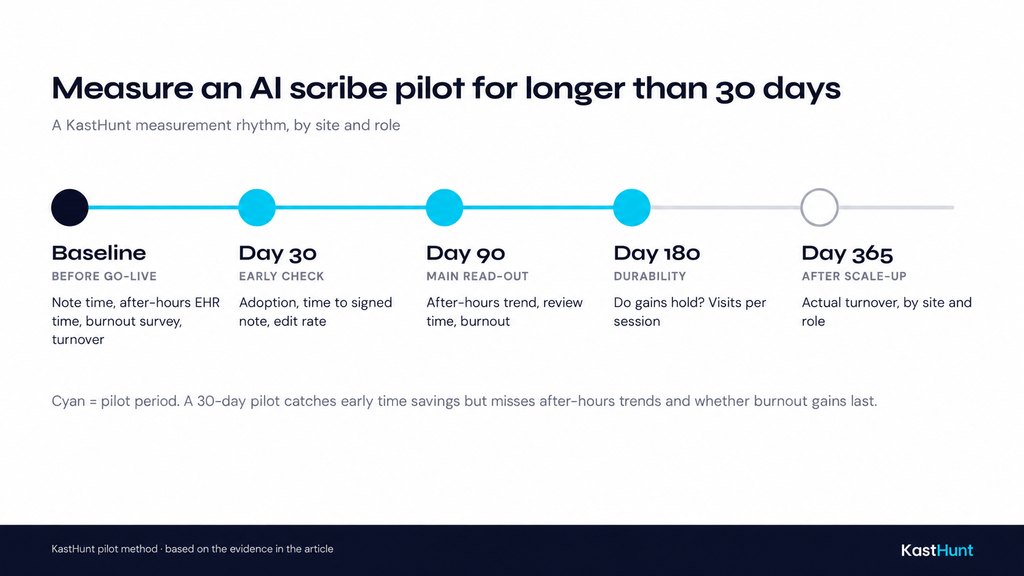
A 30-day pilot can show early documentation effects, but it may be too short to judge longer-term behaviour.
KastHunt’s practical recommendation is to measure at 30, 90 and 180 days during rollout, then again at 365 days after broader deployment.
This is an implementation recommendation rather than a universal research standard.
The reason for the longer window is simple:
- note-time changes can appear quickly;
- after-hours effects may build more gradually;
- clinician behaviour changes with familiarity;
- burnout and retention need longer observation.
Which metrics matter more than clinician satisfaction?
Satisfaction matters, but it should not stand alone.
A stronger evaluation includes:
- time to signed note
- edit rate
- clinically significant corrections
- after-hours EHR time
- cognitive workload
- burnout
- actual clinician turnover
- adoption rate
High satisfaction does not necessarily mean low error rates, meaningful workload reduction or broad adoption.
How can organisations stop saved time from becoming extra workload?
Before starting the pilot:
- decide whether time saved should support patient attention, earlier finishes, additional capacity or another defined goal;
- avoid immediately increasing visit targets during evaluation;
- count review and correction time;
- monitor inbox and administrative workload;
- include nurses, receptionists, AHPs and coordinators where documentation burden extends beyond physicians.
Otherwise, an organisation may technically save documentation time without reducing the workload clinicians experience.
How KastHunt approaches AI-scribe evaluation
KastHunt approaches ambient AI implementation as a workflow and measurement problem, not simply a note-generation problem.
For a scribe pilot, the starting point is a baseline: how much documentation work exists today, who performs it, where it occurs and how it affects the wider clinical workflow.
The pilot can then measure documentation time, review burden, adoption, clinician experience and performance by role and site.
EveStella, KastHunt’s ambient AI scribe, follows the same review-first approach. Generated notes remain drafts until the clinician reviews and approves them, and the platform exposes measures such as sign-off time, edit rate and documentation completeness.
KastHunt does not claim that an AI scribe solves clinician burnout.
The more useful question is:
Is the technology reducing the documentation workload that matters in this particular clinical workflow?
Is your AI-scribe pilot measuring the right outcomes?
Reducing note-writing time is useful, but it does not tell you whether clinician workload, review burden, adoption or burnout are actually improving.
KastHunt helps healthcare organisations map the workflow first, define measurable pilot outcomes and test clinical AI before wider deployment.
Frequently asked questions
What is pajama time in healthcare?
Pajama time is time clinicians spend working in the EHR outside scheduled clinical hours, often in the evening or at home. Researchers also use terms such as “work outside of work” or WOW. Several AI-scribe studies report reductions, although the size and statistical significance vary.
Do AI scribes improve work-life balance?
They can, particularly when they reduce unfinished documentation and after-hours charting. However, the benefit depends partly on what the organisation does with the time saved.
Can AI scribes create additional review workload?
Yes. Every AI-generated clinical note still requires appropriate review, correction and approval. Healthcare organisations should therefore measure review time and edit rates rather than counting only the typing time removed.
Is clinician satisfaction enough to judge an AI scribe?
No. Satisfaction should be evaluated alongside documentation time, review burden, errors, after-hours EHR use, burnout, adoption and retention.
Do AI scribes prevent doctors from leaving practice?
That has not been proven. Some organisations report improved intention to stay and lower turnover after deployment, but controlled evidence showing that AI scribes directly reduce long-term clinician turnover is not yet available.
Do patients accept AI scribes?
Patient acceptance has been high in several studies and pilots, but it varies by setting and consent approach. Patients should be informed appropriately and given the required choices under local professional and privacy requirements.
Do AI scribes help nurses?
The evidence is still limited. Most published studies focus on physicians and advanced practice clinicians. As ambient tools expand into nursing and other roles, those workflows should be evaluated separately.
How long should an AI-scribe pilot run?
Thirty days can measure early effects, but longer monitoring provides a better view of adoption, after-hours workload and durability. KastHunt’s practical approach is to check outcomes at approximately 30, 90 and 180 days and again after broader scale-up.
Related reading
- How Accurate Are AI Medical Scribes? What the Studies Actually Measured
- Why Clinicians Preferred AI Notes Even When They Hallucinated More Often
- Who Is Accountable When an AI Scribe Gets a Note Wrong?
- How to Choose an AI Clinical Scribe for Multi-Site Providers
- Best AI Clinical Scribe Platforms in 2026
Sources
- NEJM AI — randomized ambient-scribe trial — documentation time, product differences and clinician experience.
- JAMA — multisite ambient-scribe study — documentation time, EHR time, usage intensity and visit volume.
- JAMA Network Open — six-health-system study — burnout, cognitive workload and documentation burden.
- JAMA Network Open — Mass General Brigham and Emory evaluation — burnout and documentation-related well-being.
- JAMA Network Open — Providence study — longitudinal documentation behaviour and adoption.
- JMIR Medical Informatics — Hawaii Pacific Health — note time, pajama time and burnout.
- JAMA Network Open — Penn Medicine — note time and after-hours documentation.
- Canada Health Infoway — National AI Scribe Program — time savings, cognitive load and clinician engagement.
- JMIR / Singapore evaluation — documentation time, eye contact and consultation workflow.
- npj Digital Medicine — Dutch general-practice study — documentation time and perceived workload.
- Great Ormond Street Hospital / NHS evaluation — patient interaction time and emergency-care productivity.
- PHTI — ambient scribe assessment — burnout, productivity and financial evidence gaps.
- Ontario AI-scribe assessment — documentation errors across evaluated products.