How to Choose an AI Clinical Scribe for Multi-Site Providers
A practical 2026 guide to choosing an AI clinical scribe across multiple sites, covering EHR integration, governance, safety, regional compliance, rollout and vendor evaluation.

How should a multi-site provider choose an AI clinical scribe? Judge each platform on eight things: central governance, per-site configuration, EHR write-back at every site, clinicians moving between sites, roles beyond the doctor, data location, regional compliance, and proof of safety. Then run the same five-workflow demo with every vendor and score them on one sheet. A scribe that works well in one clinic can still fail across ten sites with different EHRs and rules.
Key takeaways
- Multi-site is a different buying problem. Note quality matters, but so do admin control, site templates and EHR coverage across your whole estate.
- The evidence for AI scribes is strong but modest per clinician. A six-health-system study found burnout fell from 51.9% to 38.8% after 30 days; Canada’s national programme found clinicians saved 1.11 hours a week in work hours after six months.
- Value comes from adoption at scale. Providence’s study of 1,500+ clinicians found modest gains per person that added up across the system — but only about 8% of eligible clinicians had adopted by the study’s end.
- Every scribe makes errors. In Ontario’s assessment, all 20 products produced some incorrect medical information. Governance and clinician review must be built in from day one.
- Rules differ by region. The UK, Canada, New Zealand and Australia now each have their own supplier lists, guidance or reviews. Check them before you shortlist.
Why choosing an AI scribe is harder for multi-site providers
A single clinic asks one question: does this scribe write good notes for our doctors? A group with five, twenty or a hundred sites has to ask several more.
| Single clinic | Multi-site group |
| One EHR | Often two or more EHRs, sometimes after acquisitions |
| One set of templates | Head-office standards plus local variation by site and specialty |
| Clinicians work in one place | Clinicians and locums move between sites |
| A practice manager runs it | Central IT, clinical governance and site managers all need control |
| One set of local rules | Sites may sit in different states, provinces or countries |
| Success = time saved per clinician | Success = consistent adoption, quality and cost across the estate |
Why this matters now. Adoption is spreading fast, but full deployment lags. Canada’s national programme grew from about 245,000 AI-assisted encounters a month in June 2025 to over 1.22 million by February 2026. Yet in one US survey, every responding health system had at least piloted ambient documentation while only 14% had it fully deployed. The gap between pilot and estate-wide rollout is where multi-site providers win or lose.
The documentation burden is not just a doctor’s problem. In a multi-site group, receptionists, nurses, care coordinators and admin teams all create records. A scribe that only serves the doctor leaves much of the burden — and much of the data — untouched.
The 8 criteria for choosing an AI scribe across multiple sites
1. Can head office control templates while each site adapts them?
Look for two levels of control. Central teams should set mandatory note sections, coding rules and safety settings. Authorised site admins should then adjust allowed fields for their specialty or local process. Without this, you either get chaos (every site does its own thing) or a rigid tool nobody uses.
Ask the vendor: “Show me a mandatory template set centrally, then changed for one site, with an audit trail of who changed what.”
2. Does the note write back into every EHR you run?
This is usually the deciding factor. Write-back comes in four levels, from best to weakest:
- Native write-back inside the EHR (structured fields, launched from the chart)
- Launch from the EHR with patient context, note sent back as a document
- Browser extension that fills EHR fields
- Copy and paste
The deepest integrations today are mostly Epic-first. If your sites run different EHRs, ask for the level each one gets — not just a logo list.
Ask the vendor: “For each of our EHRs, which of the four levels do you support today, in production?”
3. Can clinicians work across sites without friction?
Locums and specialists often cover several sites. One login should give them the right site, patient, templates and EHR context wherever they work. Check that notes always land in the correct site’s record.
Ask the vendor: “Show one clinician seeing patients at two sites with different EHRs in the same day.”
4. Does it serve every role, not just the doctor?
Receptionists write check-in and call notes. Nurses write triage notes, handovers and medication lists. Admin teams need reporting. Some platforms now cover these roles; many still focus on physician notes.
Ask the vendor: “Which roles have their own outputs today, and which are on the roadmap?”
5. Where does patient data go — and can you choose?
There are three common models:
| Model | What it means | Watch for |
| Vendor cloud | Audio and notes processed in the vendor’s cloud | Which country, which subprocessors, how long data is kept |
| In-country vendor cloud | Vendor hosts data in your country | Check this is contractual, not just a default |
| Your own infrastructure | Deployed on your servers or your own AWS/Azure account | Your IT team’s role in setup and updates |
Also ask how long audio is kept (many delete within 24 hours) and whether your data is used to train models.
6. Does it meet the rules in every region you operate?
A group with sites in different countries — or different states and provinces — needs configurable consent, retention and data location per site. See the regional section below.
7. How does it prove its notes are safe?
All scribes make errors. Ask what the platform does about it:
- Can clinicians click a sentence and see the part of the conversation it came from?
- Is every note signed off by a clinician before it reaches the record?
- Are edits tracked, so you can measure how often clinicians correct the AI?
- Are there access and decision audit logs?
- Does it stay within documentation, or does it suggest diagnoses? (Diagnostic suggestions can make a scribe a regulated medical device in some regions.)
8. Can you measure value site by site?
At scale, the gains per clinician are modest; the value comes from adoption across the estate. You need a dashboard by site showing notes completed, time to sign-off, edit rate, documentation completeness and adoption. Without this, you cannot tell which sites need coaching and which are ready to expand.
Regional requirements: what to check where you operate
This is a summary, not legal advice. Confirm the current rules with your compliance team before you buy.
United Kingdom
- NHS England publishes guidance on ambient scribing for CIOs and CCIOs, and runs a national self-certified AVT Supplier Registry to support local procurement. NHS England listed 19 registered suppliers in January 2026.
- Being on the registry is not a contract or a commercial framework, but it is a strong first filter.
- Suppliers and NHS organisations must meet the Data Security and Protection Toolkit (DSPT) and hold Cyber Essentials, and comply with UK GDPR. NHS England provides a DPIA template.
- Expect a DCB0129 clinical safety case from the supplier and complete DCB0160 yourself.
- The MHRA published guidance in July 2026 on when AVT products are medical devices.
United States
- HIPAA: the vendor must sign a Business Associate Agreement (BAA).
- Ask for SOC 2 Type II (or HITRUST) evidence.
- Check state rules on recording consent and on generative AI in patient communications.
- Scribes that only document generally fall outside FDA device rules; tools that recommend diagnoses or treatment may not.
Australia
- The TGA says a scribe that only transcribes is not a medical device, but one that suggests diagnoses or treatment may be. The TGA is reviewing digital scribes.
- Practices remain responsible for privacy law, cybersecurity and AHPRA requirements even when the scribe is not a device.
- Patient consent is required before an AI scribe is used.
- Prefer onshore data processing and storage; RACGP and the Australian Commission on Safety and Quality in Health Care have published guidance.
Canada
- Comply with PIPEDA plus provincial health privacy law (for example PHIPA in Ontario, Law 25 in Quebec, the HIA in Alberta).
- In Ontario, check Supply Ontario’s AI scribe Vendor of Record list. 18 vendors were approved as of early 2026, with a further intake in progress.
- Canada Health Infoway’s national programme pre-qualified a set of vendors; its evaluation covered 12,019 primary care clinicians.
- Prefer Canadian data residency.
New Zealand
- Health NZ is setting up an open panel of AI scribe suppliers. Patient data must be hosted in New Zealand or Australia and comply with the Privacy Act 2020 and Health Information Privacy Code 2020.
- Plan for explicit consent and an easy opt-out, and test accuracy with New Zealand accents and te reo Māori.
European Union
- GDPR applies, including lawful basis, data minimisation and transfers outside the EU.
- Under EU MDR, some scribes are certified medical devices (one European scribe holds Class IIa). Ask each vendor for its classification.
- The EU AI Act adds transparency and governance duties, which are heavier for high-risk systems.
For groups across several regions: choose a platform where consent wording, audio retention, data location and coding standards (ICD-10, SNOMED CT, MBS, provincial codes) can be set per site, not just per contract.
The five-workflow demo script
Give every vendor the same script, in your own EHR test environment where possible. Sales demos on the vendor’s own sample data hide most multi-site problems.
- One clinician, two sites. A clinician signs in once, sees patients at two sites with different EHRs, and gets the right template and patient context at each.
- Central template, local change. Head office sets a mandatory template; one site admin adds a permitted local field; the audit log shows both changes.
- Note to the right record. A full consultation becomes a signed note that lands in the correct patient, encounter and site — with no copy-paste where full integration is promised.
- Beyond the doctor. A receptionist check-in summary and a nurse triage or handover note are produced from real conversations.
- Adding a new site. The vendor walks through onboarding a site with a different EHR or specialty mix, with a realistic timeline and who does what.
Use recorded or simulated consultations with your own clinicians, covering at least one complex visit, one with interruptions and one with a strong accent or second language.
Scorecard
Score each vendor from 1 (poor) to 5 (excellent). Adjust weights to your priorities; the default totals 100.
| Criterion | Weight | Vendor A | Vendor B | Vendor C |
| Central governance and site templates | 15 | |||
| EHR write-back across all sites | 20 | |||
| Cross-site clinician workflow | 10 | |||
| Roles covered beyond the doctor | 10 | |||
| Data location and control | 10 | |||
| Regional compliance | 15 | |||
| Safety: source links, sign-off, audit logs | 10 | |||
| Site-level reporting | 5 | |||
| Accuracy on your test consultations | 5 | |||
| Weighted total (score × weight ÷ 5) | 100 |
How to measure accuracy fairly: have two clinicians rate each draft note for omissions, errors and anything added that was not said. Track the clinician edit rate during the pilot, not just in the demo.
A realistic rollout timeline
Vendors often quote days. For a multi-site group, plan in weeks, and treat the first site as the template for the rest.
| Phase | What happens | Typical time |
| Pre-work | Contract, DPIA or privacy assessment, security review, clinical safety owner named | 1–4 weeks (mostly on your side) |
| Set-up | Environment, sites, roles, single sign-on, consent and retention rules | 1 week |
| Templates | Role and specialty templates, regional coding | 2–5 days |
| EHR integration | Connect and test write-back | 3 days to 3 weeks per EHR |
| Test and safety sign-off | User testing, hazard log review | 3–5 days |
| Pilot site go-live | Training, daily check-ins for two weeks | 2 weeks |
| Each further site (same EHR) | Configuration, training, go-live | About 1 week |
Adoption is the real milestone. In Providence’s large study, voluntary adoption reached only about 8% of eligible clinicians. Plan clinical champions per site, short training, and a weekly look at the site dashboard.
Red flags when evaluating vendors
- They show a logo list of EHRs but cannot say which integration level each gets.
- The demo only uses their sample data, never your EHR or your consultations.
- No way to trace note text back to the conversation.
- Admin controls are per user only, with no site or central level.
- Vague answers on where audio goes, how long it is kept, or whether it trains models.
- The scribe offers diagnoses or treatment suggestions without a clear regulatory position.
- Pricing changes per clinician with no cap, making estate-wide rollout unpredictable.
- No site-level reporting, so you cannot see where adoption is failing.
Where EveStella fits
Disclosure: KastHunt builds EveStella. We built it for the multi-site problem described here: one flow from patient intake to front desk, nurse, doctor and admin insight; central control with per-site settings; and deployment inside your own servers or cloud account so patient data stays in your boundary. It does not diagnose, and every note is signed off by a clinician. For a side-by-side view of 15 platforms, see Best AI Medical Scribes in 2026.
Frequently asked questions
What is the best AI scribe for multi-location clinics?
The best one is the platform that writes back into every EHR you run, gives head office control while letting sites adapt, and meets each region’s rules. Run the same five-workflow demo with each shortlisted vendor and score them on one sheet.
How long does it take to roll out an AI scribe across several sites?
Plan about 3–6 weeks for the first site after contracts and privacy reviews, then roughly a week for each further site on the same EHR. Different EHRs add integration time.
Do AI scribes reduce burnout?
The evidence is encouraging. A study across six US health systems found burnout fell from 51.9% to 38.8% after 30 days. Canada’s national programme found clinicians saved an average of 1.11 hours a week during work hours after six months.
How do we keep AI-generated notes safe?
Require clinician sign-off on every note, use tools that link note text to the source conversation, track edits, and keep audit logs. Review a sample of notes each month per site.
Should our AI scribe run in the cloud or on our own servers?
Cloud is faster to start. Your own infrastructure gives more control over where patient data goes and suits groups with strict data rules. Some platforms support both.
What should we measure in a pilot?
Time from end of visit to signed note, clinician edit rate, after-hours documentation, documentation completeness and adoption rate by site.
What makes implementing AI clinical scribe software in healthcare complex?
Three things: EHR integration (every EHR, and sometimes every site’s configuration, behaves differently), governance (consent, data location, clinical safety sign-off) and adoption (clinicians must trust and use it). Across several sites, each of these multiplies.
How do AI clinical scribe platforms affect EHR data quality?
They can improve it — more complete, more timely notes — or harm it, if errors or invented details reach the record unchecked. Protect data quality with mandatory clinician sign-off, source-linked note text, edit tracking, structured write-back instead of copy-paste, and a monthly audit of sample notes per site.
Which AI clinical scribe platforms work best for large hospital networks?
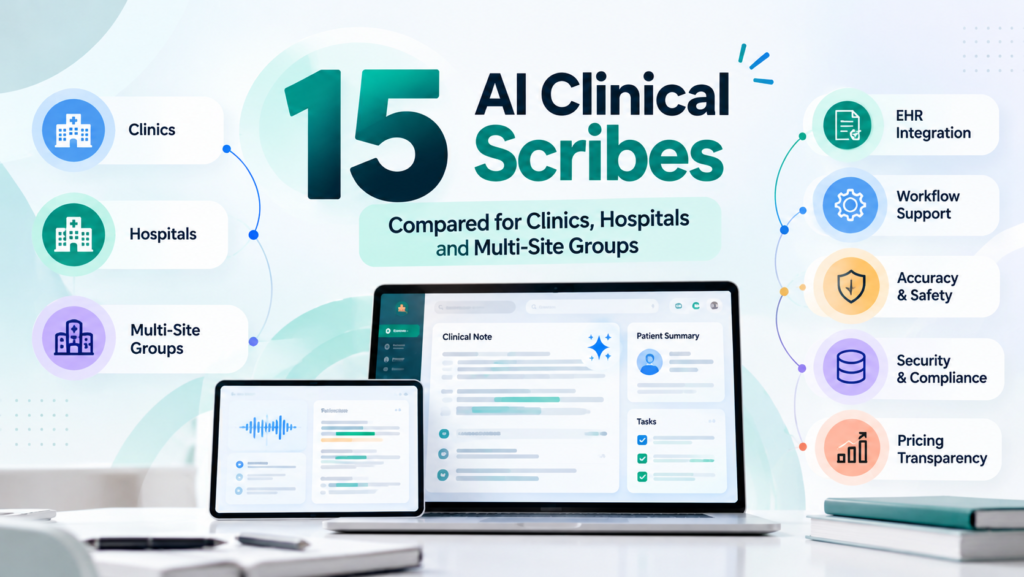
Networks usually shortlist platforms with deep hospital EHR integration and inpatient, emergency and nursing support — such as Epic AI Charting, Abridge, Microsoft Dragon Copilot, Ambience and Oracle Health Clinical AI Agent — plus multi-EHR options like Nabla and Commure. See our comparison of 15 AI clinical scribe platforms.
Want help building your shortlist and scorecard?

Download Scorecard:
Sources
- JAMA Network Open via Epocrates — six-health-system burnout study · Newswise — Yale study summary
- Becker’s — Providence study of 1,547 clinicians
- Canada Health Infoway — national AI Scribe Program results · Infoway clinician forum — results summary
- IntuitionLabs — US hospital AI adoption data
- C.D. Howe Institute — Supply Ontario accuracy finding
- NHS England — ambient scribing guidance and registry · Pharmaceutical Journal — 19 registered suppliers · Bird & Bird — NHS compliance framework
- AGPAL — TGA and RACGP guidance · Lyrebird — patient consent in Australia
- Mondaq — AI scribes and Canadian privacy
- eHealthNews NZ — Health NZ supplier panel
- Tandem Health — EU MDR Class IIa