NHS Ambient Voice Technology Guidance 2026: What Buyers Must Check Before Choosing an AI
Choosing an NHS AI scribe requires more than checking whether the supplier appears on the AVT Registry. This 2026 guide explains what buyers should verify across clinical safety, MHRA status, information governance, EPR integration, patient transparency, contracts and post-deployment monitoring.
What must an NHS organisation check before choosing an AI scribe?
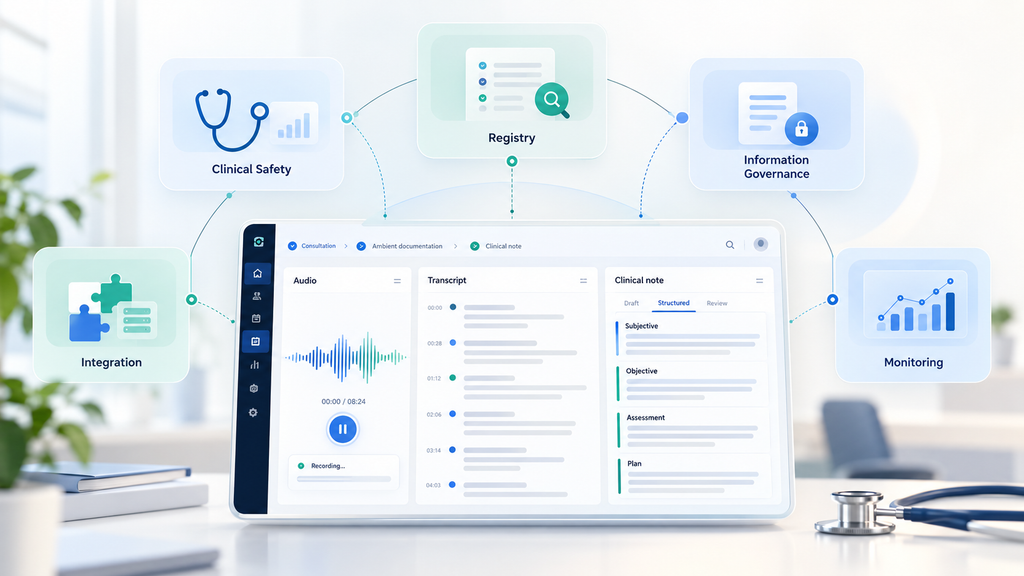
Start by confirming that the product appears on the current NHS England Ambient Voice Technology Supplier Registry where required. Then review its clinical-safety evidence, DTAC evidence, data-security position, information-governance arrangements, EPR integration, clinician-review workflow and current MHRA regulatory position.
Registry inclusion does not replace local assurance. The deploying organisation still needs to assess clinical risk under DCB0160, complete appropriate information-governance work such as a DPIA, define patient-transparency processes and monitor the system after go-live.
Key takeaways
- The AVT Supplier Registry is a procurement filter, not an NHS endorsement. Final assurance and decision-making remain with the local NHS organisation.
- There are 30 suppliers on the registry as of 8 October 2026. The list remains open and should be checked again before procurement.
- An AI scribe is not automatically a medical device. MHRA classification depends on intended purpose and functionality.
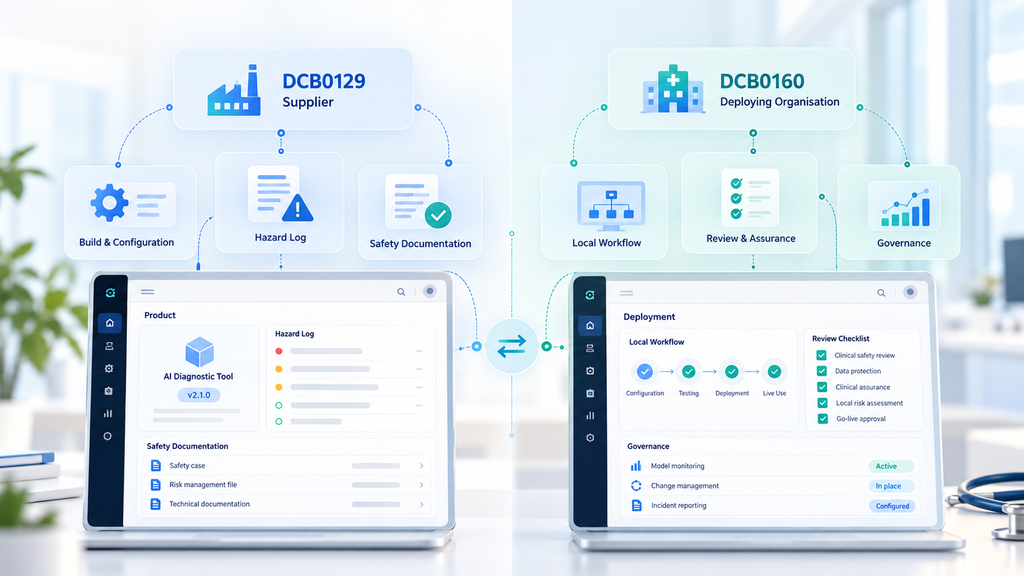
- DCB0129 and DCB0160 cover different responsibilities. Suppliers manage product-level clinical risk; deploying organisations manage local use and implementation risk.
- A DPIA is highly likely to be required because ambient scribes typically process special-category health data using new technology.
- Safety does not end at procurement. Buyers need monitoring, incident reporting, change control and fallback processes after go-live.
- HSSIB is now investigating AVT safety nationally, showing that the evidence and governance landscape is still developing.
What changed in NHS Ambient Voice Technology guidance in 2026?
The UK AVT landscape changed substantially during 2026.
In March, NHS England published dedicated information-governance guidance for organisations using AI-enabled ambient-scribing products. It also made AVT-specific DPIA and data-processing templates available.
In July, NHS England updated its CIO and CCIO ambient-scribing guidance to Version 3, aligning it with new MHRA guidance on AVT medical-device classification.
The MHRA published its dedicated AVT regulatory guidance on 29 July 2026, clarifying that medical-device status depends on what a product is intended to do rather than simply whether it uses AI.
By 8 October 2026, the NHS England AVT Supplier Registry had grown to 30 suppliers.
NHS England is also moving from isolated adoption towards wider national scaling, beginning with outpatient settings and developing a national benefits framework to measure impact more consistently.
What is the NHS AVT Supplier Registry?
The Ambient Voice Technology Self-Certified Supplier Registry is NHS England’s national list of AVT suppliers that have submitted evidence against the registry criteria.
As of 8 October 2026, 30 suppliers are listed.
The current list includes companies such as Accurx, Corti, Heidi Health, Lyrebird Health, Microsoft Dragon, Tandem, Tortus and T-Pro, among others.
NHS organisations can review supplier evidence through the NHS England National Commercial and Procurement Hub.
The registry is not a commercial framework, and NHS England states clearly that:
all assurance and decision-making remains with the local NHS organisation.
Applications remain open, so the registry should always be checked live rather than relying on an article or static list.
Is being on the NHS AVT Supplier Registry enough?
No.
Registry inclusion helps NHS organisations shortlist suppliers and access submitted assurance evidence, but it does not remove local procurement, information-governance or clinical-safety responsibilities.
In August 2026, the government stated that NHS organisations are currently required to select AVT products from the registry, including AVT functionality embedded inside wider EPR products.
However:
Registry inclusion is a procurement gateway, not a substitute for local assurance.
The organisation still needs to determine whether the specific product, configuration, workflow and intended use are safe and appropriate for its setting.
Is an AI scribe a medical device in the UK?
Not automatically.
The MHRA’s July 2026 guidance says medical-device status depends on the product’s intended purpose and functionality.
Functions limited to areas such as:
- transcription;
- summarisation;
- drafting clinical documentation;
- generating correspondence;
- suggesting codes for clinician review
may fall outside medical-device regulation depending on their intended purpose.
Functions intended to support areas such as:
- diagnosis;
- treatment;
- prevention;
- clinical decision-making;
- automated clinical actions
may meet the definition of a medical device.
This means buyers should not ask only:
“Is this product registered?”
They should also ask:
“What is the intended purpose of every clinical function we will actually use?”
A product can also change after procurement, so its regulatory position may need to be reconsidered if significant new functionality is introduced.
What do DCB0129 and DCB0160 mean for an AI scribe?
DCB0129 and DCB0160 divide clinical-risk responsibility between the supplier and the organisation using the technology.
| Requirement | What it covers | Primary responsibility |
| DCB0129 | Clinical-risk management during development and maintenance of the health IT product | Manufacturer / supplier |
| DCB0160 | Clinical-risk management during deployment and use | NHS organisation |
| DTAC | Clinical safety, data protection, technical security, interoperability and usability | Supplier evidence reviewed by buyer |
| DSPT | Protection and handling of NHS health information | Relevant supplier and NHS organisation |
| Cyber Essentials / Plus | Cyber-security controls | Supplier evidence |
| DPIA | Privacy risks, lawful processing, data flows and mitigation | NHS organisation with supplier input |
| MHRA assessment | Whether particular functionality falls within medical-device regulation | Manufacturer determines; buyer verifies |
| AVT Registry | National supplier evidence supporting procurement | Supplier submits; local NHS organisation assures |
DCB0129 applies to manufacturers of health IT systems, while DCB0160 applies to organisations deploying and using those systems. Compliance with the standards remains mandatory in England.
Both standards are currently being reviewed to better address AI, modern development methods and post-deployment monitoring, but the existing standards remain the current framework while that work continues.
Who owns clinical safety after an AVT product is deployed?
Buying a product with DCB0129 documentation does not automatically give an NHS organisation a local safety case.
The organisation still needs to assess how the product operates inside its own clinical environment.
NHS England recommends:
- assigning appropriate clinical-safety ownership;
- reviewing supplier hazards and controls;
- completing DCB0160 documentation;
- developing the local safety case;
- maintaining a hazard log;
- establishing monitoring processes;
- considering integration and system-failure risks.
Typical AVT hazards can include:
- missing clinical information;
- incorrect information;
- incorrect context;
- delayed outputs;
- integration failure;
- system unavailability;
- data loss.
The important buyer question is therefore not:
“Does the supplier have a safety case?”
It is:
“How does the supplier’s safety evidence translate into our own workflow, users and clinical risks?”
What should NHS buyers check about AVT data flows?
Do not stop at:
“The supplier is UK GDPR compliant.”
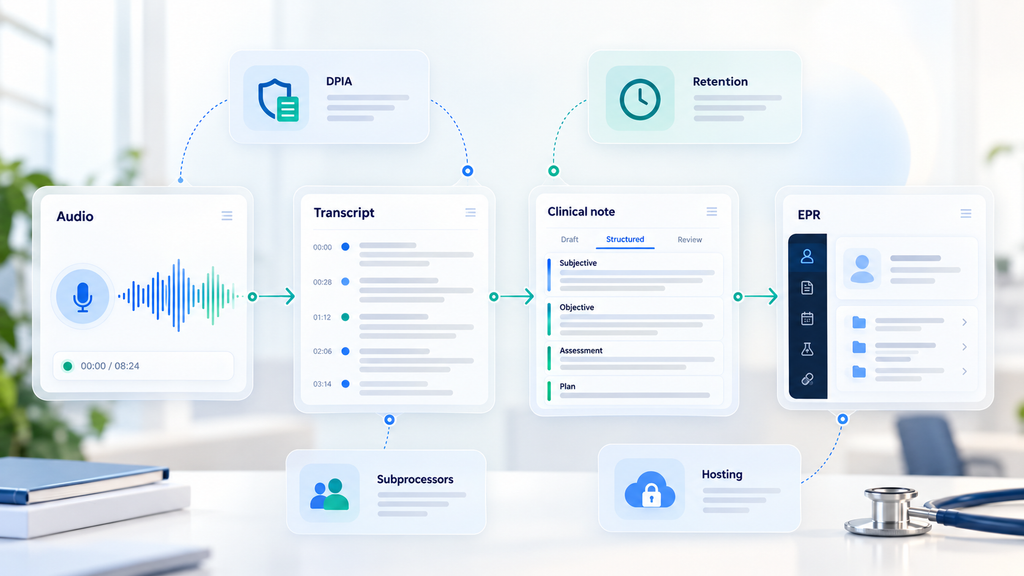
Map the data flow.
Buyers should ask:
- What happens to the raw audio?
- Is the transcript retained?
- Is the final clinical note retained separately?
- Where does model inference happen?
- Which countries process the data?
- Which subprocessors receive patient information?
- Which LLM or AI providers are involved?
- Is patient data used to train or improve models?
- What are the retention periods for audio, transcripts and outputs?
- What happens after deletion?
- Can suppliers change subprocessors without notifying the organisation?
- What data is transferred back into the EPR?
- What security and audit logs are retained?
NHS England’s IG guidance says organisations need to document controller and processor roles carefully and ensure patient data is not used by the technology provider for purposes outside the individual’s care unless there is a valid and appropriately governed basis.
NHS England also provides AVT-specific DPIA and Data Sharing and Processing Agreement templates.
Does an NHS organisation need a DPIA before using an AI scribe?
In most health and care settings, a DPIA is highly likely to be required.
NHS England identifies several reasons:
- ambient scribes usually process special-category health information;
- processing can occur at significant scale;
- the technology involves automated processing;
- the technology is relatively new and not widely understood by the public.
A supplier’s documentation can support the DPIA.
It does not replace the organisation’s own assessment.
How should patient transparency and consent work?
For ambient scribes used for individual care, NHS England’s current professional guidance says explicit consent is not necessarily required in every consultation.
Instead, organisations can rely on implied consent under the common-law duty of confidentiality where appropriate.
However, patients must be informed that an ambient scribe is being used and given the opportunity to object. If the person objects, the organisation can no longer rely on implied consent for that use.
Patients should therefore be told, in a clear and accessible way:
- that AVT is being used;
- what it does;
- what information it processes;
- what happens to the generated output;
- what choices they have;
- how they can object.
The organisation’s privacy notice should also explain its use of ambient-scribing technology.
Are there consultations where AVT may not be appropriate?
Yes.
NHS England advises healthcare professionals to use professional judgement, particularly during highly sensitive conversations.
Other situations may require additional care, including:
- safeguarding;
- paediatric consultations;
- distressed patients;
- conversations involving several people;
- interpreters;
- patients with speech or communication differences;
- consultations where recording could affect openness or trust.
The Royal College of Paediatrics and Child Health specifically highlights children’s speech, distress, crying, accents, dialects, neurodiversity and safeguarding as areas requiring careful evaluation.
Could AVT perform differently across patient groups?
Yes.
Speech-recognition and generative systems may perform differently depending on:
- accent;
- dialect;
- age;
- speech impairment;
- communication style;
- neurodiversity;
- clinical specialty;
- background noise;
- multiple speakers.
RCPCH recommends monitoring AVT performance across diverse populations to avoid introducing or widening inequalities.
A buyer should therefore ask for evidence from populations that resemble the patients and clinicians who will actually use the system.
How should AVT integrate with the EPR?
“EPR integration” can describe very different workflows.
Buyers should ask the supplier to demonstrate:
- how the tool launches;
- whether patient context is passed automatically;
- whether the correct encounter is selected;
- whether generated content is structured or free text;
- whether the clinician reviews before write-back;
- whether codes can be accepted or rejected individually;
- whether copy-and-paste is required;
- whether changes are audited;
- what happens when the integration fails.
The important question is not:
“Does it integrate with our EPR?”
It is:
“Which steps in the documentation workflow does the integration actually remove?”
NHS England’s national scaling programme specifically identifies EPR and clinical-workflow integration as part of safe AVT adoption.
Can clinicians trace generated content back to the consultation?
This should be tested during procurement.
If a clinician sees a medication, diagnosis, examination finding or plan in the generated note and questions it, the workflow should make verification practical.
Ask:
- Can the clinician see the relevant source transcript?
- Can the system link generated information to its source?
- Are inferred or transformed statements distinguishable?
- Can clinically important fields require explicit confirmation?
- Is the final approved version recorded?
- Is edit history preserved?
Source traceability does not eliminate errors.
It makes review more observable and practical.
How should NHS organisations test AVT accuracy before rollout?
Do not test only the vendor’s prepared demonstration.
Use realistic NHS workflows.
Test consultations involving:
- different regional accents;
- clinical abbreviations;
- rapid dialogue;
- interruptions;
- multiple speakers;
- long consultations;
- interpreters;
- specialty terminology;
- difficult audio;
- patients with communication differences.
NHS England specifically identifies complex terminology, rapid speech, accents, dialects and speech impairments as potential causes of transcription difficulty.
Measure more than overall “accuracy”.
Track:
- omissions;
- unsupported additions;
- wrong context;
- medication errors;
- clinically significant corrections;
- review time;
- edit rate.
What happens when the AVT supplier changes the model or functionality?
This is easy to miss during procurement.
AVT products can change after go-live.
Changes may affect:
- the underlying model;
- system prompts;
- clinical templates;
- coding functions;
- EPR integration;
- automated actions;
- data retention;
- hosting;
- subprocessors;
- diagnostic or treatment-related functionality.
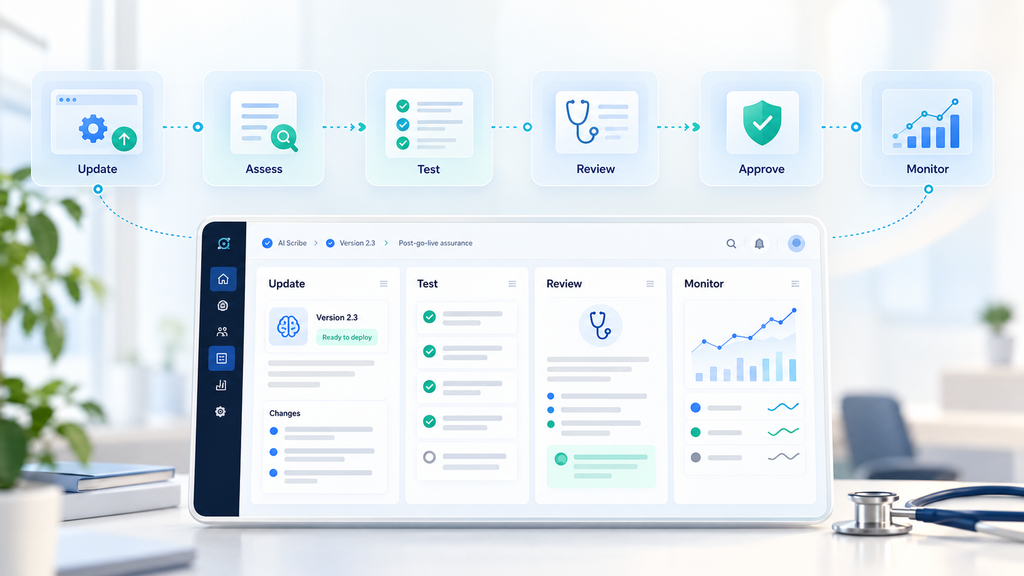
NHS England warns that generative-AI systems can introduce new functions, and MHRA classification depends on intended purpose and functionality.
Contracts and governance processes should therefore define:
supplier notification → impact assessment → regression testing → clinical-safety review → approval before significant change
where appropriate.
What should an NHS AVT contract define?
Contracts should make responsibilities explicit.
Important areas include:
- data controller and processor roles;
- subprocessors;
- data location;
- retention and deletion;
- cyber incident notification;
- clinical incident escalation;
- service availability;
- model and functionality changes;
- clinical-safety documentation;
- audit rights;
- EPR integration obligations;
- exit and transition;
- deletion or transfer of data at termination.
NHS England’s guidance says liability around AI-enabled products remains complex and recommends clear contracting arrangements that define roles, responsibilities and liability. It also highlights the potential implications when NHS organisations customise templates or other product functionality.
What happens if the AVT system is unavailable?
Every buyer should see the fallback process before go-live.
Ask the supplier to demonstrate what happens if:
- recording fails;
- only part of the consultation is captured;
- the model service is unavailable;
- EPR integration fails;
- generated output is delayed;
- patient context is incorrect.
The clinical team needs a safe manual documentation route.
System unavailability, integration failures and delayed outputs are among the technical risks NHS England tells organisations to consider during AVT risk assessment.
What should NHS organisations monitor after AVT goes live?
Procurement approval is not the end of assurance.
Track the system after deployment.
Useful measures include:
- adoption;
- note edit rate;
- review time;
- omissions;
- unsupported additions;
- clinically important corrections;
- safety incidents;
- EPR integration failures;
- patient objections;
- clinician experience;
- patient experience;
- specialty-level differences;
- model/version changes.
NHS England’s national programme is developing a benefits framework so organisations can measure AVT impact more consistently.
Post-deployment monitoring is also one of the areas identified for strengthening in the national review of DCB0129 and DCB0160.
Why is HSSIB investigating Ambient Voice Technology?
On 6 August 2026, the Health Services Safety Investigations Body launched a national investigation into the use of AVT in hospitals.
HSSIB says adoption is accelerating while some safety implications remain insufficiently understood.
The investigation is examining:
- how AVT could contribute to patient harm;
- patient-safety risks;
- how accountability is understood;
- whether AI-related incidents are being recognised and reported effectively.
Its final report is expected in summer 2027.
For buyers, that is an important reminder:
The UK AVT assurance framework is developing while deployment is already scaling.
What evidence should NHS buyers ask AVT suppliers to provide?
Compliance evidence tells you whether a supplier has addressed important governance requirements.
It does not tell you whether the system works well in your workflow.
Ask for evidence on:
- documentation accuracy;
- error types;
- clinically significant errors;
- review burden;
- time saved;
- clinician adoption;
- patient experience;
- specialty performance;
- EPR performance;
- evidence from NHS settings;
- post-deployment monitoring.
NHS England’s guidance says registry suppliers must provide evidence of real-world benefit in the NHS care setting proposed.
What should an NHS buyer ask an AVT supplier to demonstrate?
Give shortlisted vendors the same realistic workflow.
Ask them to demonstrate:
- Patient transparency — how the clinician explains AVT and handles an objection.
- Real consultation capture — not a vendor-prepared script.
- Generated documentation — using your templates.
- Source verification — checking a questionable statement.
- Clinician correction — editing an error or omission.
- Clinical approval — showing exactly when the note becomes final.
- EPR write-back — to the correct patient and encounter.
- Audit trail — user, timestamp, version and changes.
- Failed recording — safe recovery or manual fallback.
- Template or model change — what governance is triggered.
- Incident reporting — how an error is escalated.
- New specialty rollout — what needs to be reconfigured and retested.
A vendor that cannot demonstrate these workflows is giving you a product demo, not implementation evidence.
What are the red flags when evaluating an NHS AVT supplier?
Be cautious when:
- “NHS approved” is used without explaining what it means;
- registry inclusion is presented as full NHS assurance;
- the MHRA regulatory position is unclear;
- DCB0129 evidence is unavailable;
- data location is vague;
- subprocessors are unclear;
- audio-retention answers are vague;
- there is no explicit clinician-review workflow;
- outputs cannot be traced or audited;
- significant model changes can occur without notification;
- “EPR integration” actually means copy-and-paste;
- only vendor-prepared demonstration data is available;
- there is no incident-reporting process;
- there is no safe downtime workflow.
Does this guidance apply outside England?
The NHS England AVT Supplier Registry and NHS England ambient-scribing guidance apply to England.
Scotland, Wales and Northern Ireland have their own health-system governance and procurement arrangements.
MHRA’s July 2026 AVT guidance discussed in this article applies to Great Britain — England, Scotland and Wales.
UK GDPR and wider data-protection requirements also need to be considered, but organisations outside England should follow the relevant national and local procurement, information-governance and clinical-safety requirements rather than assuming NHS England’s process applies unchanged.
How KastHunt approaches AVT assurance
KastHunt approaches healthcare AI implementation from the workflow outward.
For an ambient-scribing deployment, that means looking at:
intended purpose → clinical workflow → EPR integration → data flow → clinical risk → clinician review → measurable pilot → post-deployment monitoring
The objective is not simply to determine whether a technology has the right documents.
It is to determine whether the technology can operate safely and usefully inside the organisation’s actual clinical workflow.
KastHunt’s public healthcare-AI approach similarly emphasises clinical workflow, human review, integration and testing technology in real workflows before wider investment.
KastHunt should only make NHS-specific product-compliance claims once the relevant evidence, certifications and registry status are complete and verifiable.
Preparing an NHS AVT procurement or pilot?
Registry status is only the beginning.
KastHunt helps healthcare organisations map the workflow, integration, clinical-risk and measurement questions that need to be resolved before healthcare AI is scaled.
Frequently asked questions
How many suppliers are on the NHS AVT Supplier Registry?
As of 8 October 2026, NHS England lists 30 suppliers. The registry remains open, so buyers should check the live NHS England registry before creating a shortlist.
Does being on the NHS AVT Supplier Registry mean a supplier is NHS approved?
No. The registry supports local procurement and assurance, but NHS England says final assurance and decision-making remain with the local NHS organisation.
Does an NHS organisation have to choose an AVT product from the registry?
At present, yes. In an August 2026 Parliamentary answer, the government stated that NHS organisations are required to select AVT products from the registry, including products embedded within EPR systems.
Is an AI scribe a medical device in the UK?
Not automatically. MHRA classification depends on intended purpose and functionality. Documentation-only functions may fall outside medical-device regulation, while functions supporting diagnosis, treatment, prevention or automated clinical action may qualify as medical devices.
What is the difference between DCB0129 and DCB0160?
DCB0129 covers clinical-risk management for manufacturers of health IT, while DCB0160 covers clinical-risk management by organisations deploying and using health IT. Both remain current requirements in England while NHS England reviews the standards.
Does an NHS organisation need a DPIA for an AI scribe?
A DPIA is highly likely to be required. NHS England provides a dedicated ambient-scribing DPIA template because these systems typically process special-category health data using new automated technology.
Do patients need to give explicit consent to an NHS AI scribe?
Not necessarily for individual care. NHS England says implied consent may be appropriate under the common-law duty of confidentiality, but patients must be informed and allowed to object.
Who reviews an AI-generated clinical note?
The clinician remains responsible for appropriately reviewing and validating the output before relying on it as part of patient care or the clinical record. NHS England guidance repeatedly emphasises clinician review and revision of generated outputs.
What should NHS organisations monitor after deploying AVT?
Monitor adoption, review burden, errors, clinically important corrections, incidents, EPR failures, patient experience, clinician experience and model changes. Monitoring should continue after the pilot rather than stopping at go-live.
What happens if the AVT supplier changes its model?
Significant changes should trigger assessment rather than being treated as routine software updates. Model, prompt, functionality, data-processing or integration changes can affect clinical risk and, in some cases, regulatory status.
Related reading
- How to Choose an AI Clinical Scribe for Multi-Site Providers
- Best AI Clinical Scribe Platforms in 2026
- Who Is Accountable When an AI Scribe Gets a Note Wrong?
- Is an AI Scribe a Medical Device? MHRA, FDA and TGA Compared
- How Accurate Are AI Medical Scribes? What the Studies Actually Measured
Sources
- NHS England — Ambient Voice Technology Self-Certified Supplier Registry — current supplier list and local assurance responsibility.
- NHS England — Guidance on AI-enabled ambient scribing products — clinical safety, implementation, contracts, liability, training and monitoring.
- MHRA — Ambient voice technology-enabled products — intended purpose and medical-device classification.
- NHS England — Information governance guidance for ambient scribes — data controllers, processors, retention, security and individual rights.
- NHS England — Ambient-scribing DPIA template — DPIA requirements and implementation support.
- NHS England — Clinical Risk Management Standards — DCB0129 and DCB0160 responsibilities.
- NHS England — National review of DCB0129 and DCB0160 — current review and AI-related update needs.
- HSSIB — The use of Ambient Voice Technology in hospitals — national patient-safety investigation.
- RCPCH — Ambient Voice Technology position statement — paediatrics, safeguarding, equity and diverse speech.
- UK Parliament — Ambient Voice Technology registry requirements — current requirement to select AVT products from the Registry.