The Blind Spot in Clinical AI Marketing
If you have followed the rise of ambient AI scribing over the past two years, you will have noticed something: almost every case study, every product demo, every press release features a physician. A GP finishing their notes in minutes. A consultant completing a ward round summary hands-free. A hospitalist walking out on time for the first time in months.
These are real and important use cases. But they represent, at most, 30% of the clinical workforce.
The remaining 70% — nurses, midwives, health visitors, physiotherapists, occupational therapists, speech and language therapists, dietitians, paramedics, care coordinators, and dozens of other clinical roles; carry documentation burdens that are, in many cases, heavier than their physician colleagues. And they have been almost entirely absent from the ambient AI conversation.
That needs to change.
The Nursing Documentation Reality
What Nurses Actually Document
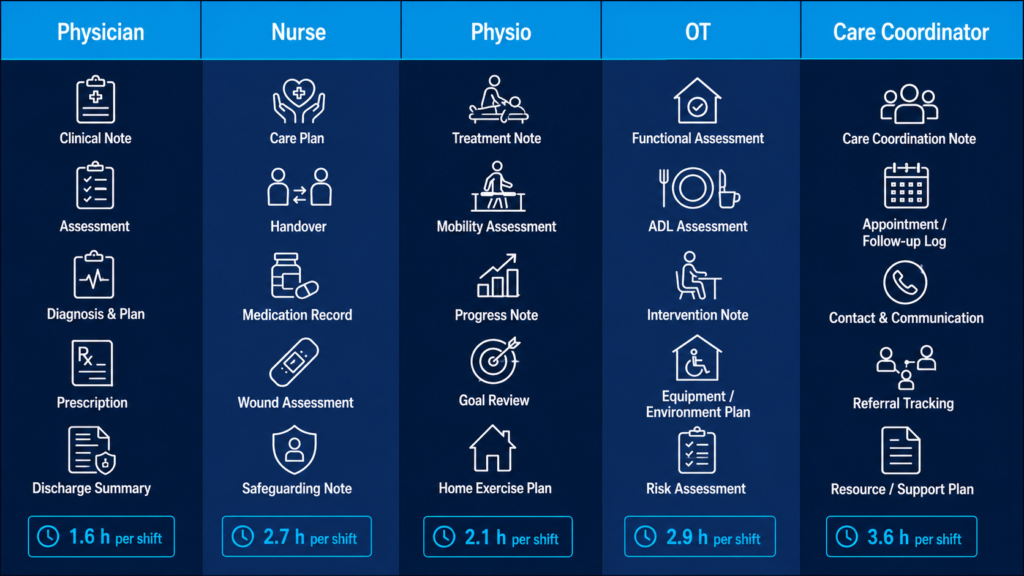
The scope of nursing documentation is vast and varies significantly by setting, but across primary, secondary, and community care, nurses routinely produce:
- Admission and assessment records — comprehensive patient history, physical assessment, risk screening
- Care plans — structured, goal-oriented documents that must be updated as patient status changes
- Medication administration records — every dose, every route, every time, with clinical notes on patient response
- Handover documentation — structured summaries transferred between shifts, wards, or care settings
- Wound assessment records — detailed descriptions, measurements, photographs, treatment records
- Vital signs and observation charts — increasingly digital, but still requiring structured entry and clinical annotation
- Patient education records — documenting what was taught, patient understanding, and follow-up needs
- Safeguarding documentation — often the most time-sensitive and legally significant notes in the record
- Discharge summaries and referral letters — coordinating onward care across multiple providers
Across a 12-hour nursing shift, this documentation does not happen in one sitting. It is woven throughout the shift completed between patient contacts, at handover, during breaks, or increasingly after the shift officially ends.
The Numbers Are Worse Than for Physicians
UK nursing surveys have found that registered nurses spend an average of 3.5 to 4.5 hours per 12-hour shift on documentation and administrative tasks. That is up to 37% of a shift — in a role where every minute is already allocated.
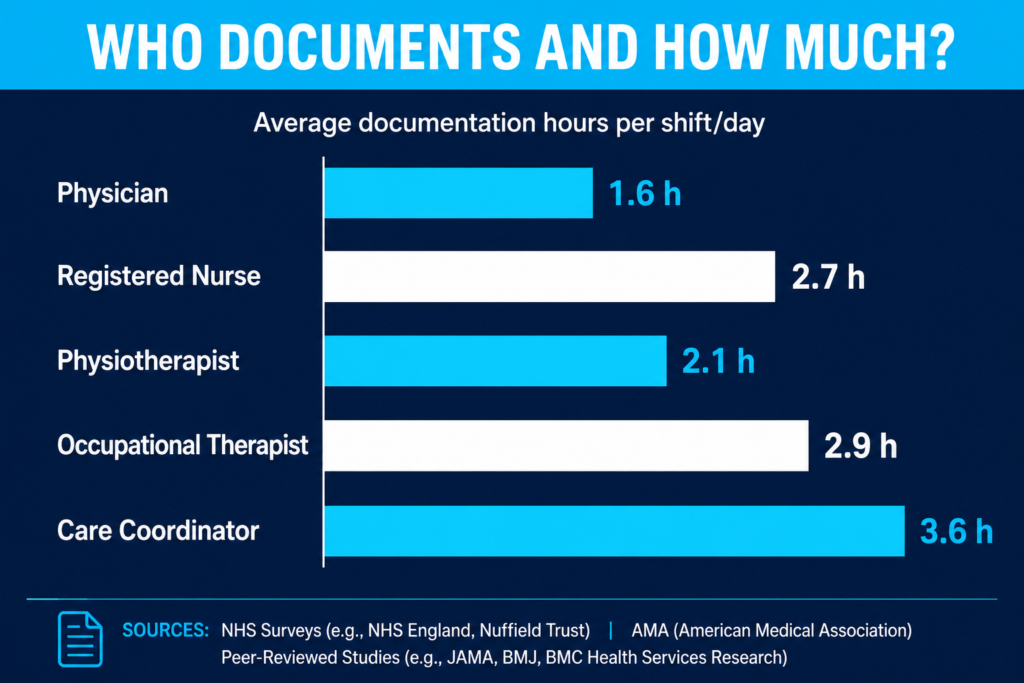
A 2023 NHS survey found that 1 in 3 nurses regularly complete documentation after their shift ends — staying late, unpaid, to finish notes that couldn’t be completed during patient care.
In the US, the American Nurses Association has documented that nurses can spend up to 35–40% of their time on documentation — time not spent at the bedside.
The consequence is not merely inefficiency. It is care quality. Every minute a nurse spends in front of a screen is a minute not spent with a patient. In high-dependency settings, in mental health wards, in community nursing — patient contact time is clinical value. Documentation, however necessary, competes with it directly.
Allied Health Professionals: The Forgotten Documentation Burden
Physiotherapists
A community physiotherapist running an outpatient clinic might see 8–12 patients in a session. Each patient requires an assessment note, a treatment record, a home exercise programme, and — for NHS patients — a standardised outcome measure. With traditional documentation, this can add 30–45 minutes of administrative time per patient.
Multiply that across a week. Across a caseload. Across a career.
Physiotherapy documentation is also highly structured and repetitive — making it particularly well-suited to AI-assisted generation. An ambient AI system that understands physiotherapy assessment language can generate a draft SOAP note, outcome measure documentation, and exercise prescription record simultaneously, from a single patient interaction.
Occupational Therapists
OT documentation is among the most complex in the allied health professions. A home assessment note for an OT might include environmental observations, functional capability assessments, equipment recommendations, risk calculations, and letters to multiple referral agencies — all from a single home visit.
OTs often complete their documentation in the community — in cars, in car parks, in patients’ driveways — before moving to the next visit. The idea that documentation should happen at a desk, in a clinical setting, is a fiction for most community AHPs.
Mobile-first ambient AI documentation — where notes are generated from a conversation during or immediately after a home visit — is transformative for this population.
Speech and Language Therapists
SLTs document clinical observations that require both technical precision and narrative nuance — describing the quality of a patient’s communication, the characteristics of a swallow, the structure of a child’s expressive language. This is not easily templated.
Ambient AI that can listen to an SLT clinical session and generate a draft that captures both structured data and clinical narrative is a significant advancement for a profession that has often found standard documentation tools poorly suited to their work.
Paramedics
Pre-hospital documentation is produced under conditions of acute clinical pressure — often in the field, often incomplete, always time-sensitive. Paramedic Patient Report Forms (PRFs) are legally significant documents and frequently scrutinised in serious incident reviews. Yet they are completed in moving ambulances, at scene, or retrospectively from memory.
Ambient AI scribing — specifically, voice-activated field documentation — has the potential to transform pre-hospital clinical record accuracy. A paramedic who can narrate clinical findings in real-time, with AI structuring them into a compliant PRF format, arrives at the ED with a complete, accurate record.
Care Coordinators: Where the Admin Load Is Heaviest
Care coordinators sit at an intersection that generates enormous documentation volume: they coordinate between primary care, secondary care, community services, social care, and patients themselves. Every contact — every phone call, every referral, every MDT discussion — needs to be recorded.
In the NHS, care coordinators working in Primary Care Networks (PCNs) are among the most documentation-intensive roles in the workforce, yet they are among the least likely to have access to clinical documentation tools.
For care coordinators, ambient AI scribing means:
- Call documentation — AI listens to a patient call and generates a structured contact record automatically
- MDT meeting notes — AI captures a multidisciplinary team discussion and produces a structured summary
- Referral letter drafting — from a verbal summary of a patient’s needs, AI generates a structured referral
- Care plan updates — AI drafts updates based on a verbal patient review
This is not speculative. The technology exists. The barrier has been that vendors have built for physicians and forgotten that care coordination is where patient journeys are actually managed.
The Case for Multi-Persona AI Scribing
The most valuable ambient AI scribe deployment is not one that serves physicians only. It is one that works across the clinical team — tailored to the documentation needs of each role.
This matters for several reasons:
1. Clinical notes connect. A patient’s record is built from contributions across multiple clinicians. If the nurse’s handover note, the physio’s assessment, and the care coordinator’s review are all generated through the same AI system — with appropriate role-specific templates — the record is more coherent and more complete.
2. Efficiency gains multiply. An NHS Trust that deploys ambient AI scribing to its nursing workforce as well as its medical staff recovers dramatically more clinical capacity than one that deploys to physicians alone.
3. Workforce retention improves across all bands. Band 5 and Band 6 nursing attrition is a significant NHS workforce problem. Documentation burden is a documented driver of that attrition. If AI scribing reduces that burden, retention improves — at every level of the workforce.
4. The ROI case gets stronger. Procurement decisions are easier to justify when the benefit is shared across a full clinical team, not just the most senior clinicians.
What This Means for AI Scribe Design
Not all ambient AI scribes are built to serve multi-persona clinical teams. Many are optimised for one consultation type — typically a GP or outpatient physician consultation — and lack the flexibility to adapt to nursing assessment language, physiotherapy SOAP structures, or care coordinator contact logs.
KH Scribe is being designed with clinical persona flexibility as a core requirement, not an afterthought. The system supports:
- Role-specific templates — nursing assessment, AHP SOAP, care coordinator contact record, and more
- Setting-appropriate workflows — ward, community, outpatient, pre-hospital
- Clinical language training — models trained on nursing and AHP documentation, not just physician notes
- Flexible deployment — on-premise, within trust infrastructure, so data governance applies equally across all clinical roles
The goal is a system that a ward nurse, a community physio, a speech therapist, and a care coordinator can all use — with documentation outputs that meet the standards of their profession, their clinical setting, and their legal obligations.
Frequently Asked Questions
Can nurses use ambient AI scribes? Yes. Ambient AI scribes can be configured with nursing-specific templates and workflows — covering assessment notes, care plans, handover documentation, medication records, and wound assessments. The technology is not physician-specific; it is consultation-specific, and nursing consultations and patient interactions are equally documentable.
How much time do nurses spend on documentation per shift? Research across NHS and international nursing workforces suggests nurses spend between 3.5 and 4.5 hours per 12-hour shift on documentation and administrative tasks — approximately 35–40% of working time.
What allied health professions benefit most from AI scribing? Physiotherapists, occupational therapists, speech and language therapists, and paramedics all carry significant documentation burdens and have specific documentation formats that AI scribing can support. Community AHPs who document in the field particularly benefit from mobile ambient AI documentation tools.
What is the difference between AI scribing for doctors and for nurses? The core technology is the same — AI listens to a clinical interaction and generates a structured record. The difference is in the template, the language model training, and the workflow integration. A nursing assessment note has different structure and terminology to a physician SOAP note or outpatient letter. Good ambient AI scribing adapts to each.
Can AI scribes help with nursing handover documentation? Yes. Handover documentation is one of the most time-pressured forms of nursing documentation and one of the most naturally suited to AI assistance. An AI that listens to an end-of-shift review and generates a structured SBAR (Situation, Background, Assessment, Recommendation) handover note can save significant time while improving handover quality and completeness.
Is AI-generated nursing documentation legally valid? AI-generated clinical documentation is reviewed and approved by the clinician before it becomes part of the clinical record. The clinician remains responsible for the content. The AI is a drafting tool — like dictation or a template — not an autonomous record-keeper. Legal validity depends on the clinician’s review and approval, not the drafting method.
How does ambient AI scribing affect patient interaction quality for nurses? By removing or reducing the need to document during or immediately after patient contact, nurses can maintain more natural, attentive interactions with patients. Research consistently shows that screen-facing during clinical encounters reduces patient trust and satisfaction — removing that requirement benefits both the nurse and the patient.
What should NHS Trusts look for when deploying AI scribes for nursing teams? Key considerations include: whether the system supports nursing-specific templates, how patient data is handled (on-premise versus cloud), whether the system integrates with existing nursing documentation systems, and whether the vendor has experience with NHS information governance requirements, including DSPT compliance.
The Bigger Picture
The ambient AI scribe conversation has been dominated by a single persona — the physician — for long enough. The clinical workforce is broader, more diverse, and more documentation-burdened than that narrative suggests.
Nurses, AHPs, and care coordinators are not secondary users of clinical AI. They are primary beneficiaries. They document more interactions, in more settings, under more time pressure, with less administrative support than their physician colleagues.
Getting ambient AI into the hands of the full clinical team — not just the most senior clinicians — is the difference between a technology initiative and a workforce transformation.
The documentation burden is not a doctor problem. It is a clinical team problem. The solution should be too.
KastHunt’s KH Scribe is an on-premise ambient clinical AI scribe designed for the full clinical team — physicians, nurses, AHPs, and care coordinators. Built for NHS data governance. Configurable for every clinical role.