The Hidden Cost of Clinical Documentation: What 3 Hours a Day Is Really Doing to Your Doctors

A Number That Should Alarm Every Healthcare System
Across multiple peer-reviewed studies and workforce surveys, the finding is consistent: physicians spend between 34% and 55% of their working time on administrative tasks — with clinical documentation accounting for the largest share.
For a full-time doctor working a 10-hour day, that is 3 to 5.5 hours. Every day. Not with patients. With paperwork.
- In the United States, the American Medical Association has documented that physicians spend nearly 2 hours on EHR tasks for every 1 hour of direct patient care
- In the United Kingdom, NHS England surveys indicate GPs spend an average of 10–12 hours per week on administrative work equivalent to two full clinical sessions lost each week
- In Australia, the AMA’s Scope of Practice Review found documentation burden as one of the top three contributors to GP workforce attrition
- In Canada, the Canadian Medical Association has flagged documentation overload as a key driver behind early retirement among family physicians
This is not a productivity problem. It is a patient safety problem, a workforce crisis, and an avoidable one.
What Happens When Doctors Spend Half Their Day on Admin
The consequences of documentation overload are well-documented and deeply serious.
Burnout at Scale
Physician burnout rates have reached crisis levels across all four major English-speaking healthcare systems. In the UK, 40% of NHS doctors report experiencing burnout symptoms with administrative burden consistently cited as a primary driver. In the US, the figure is over 50%.
Burnout does not stay in the doctor’s head. It manifests in patient interactions as shorter consultations, reduced empathy, and increased likelihood of diagnostic error. A burned-out doctor is a patient safety risk. Documentation overload creates burned-out doctors.
The Pajama Time Problem
“Pajama time” is the term clinicians use for the hours spent completing documentation after the clinic ends — at home, late at night, catching up on notes that couldn’t be finished during the working day. For many NHS GPs and hospital physicians, this is not occasional. It is every evening.
This is time taken from families, from rest, from recovery. It is unpaid. And it is a direct consequence of documentation systems that weren’t designed for clinical reality.
Consultation Quality Degradation
When a clinician is typing, they are not looking at the patient. When they are thinking about structuring a note, they are not fully listening to what the patient is saying. The cognitive load of simultaneous documentation degrades the quality of the clinical encounter itself — the very thing documentation is meant to capture.
Studies have shown that clinicians using traditional EHR documentation spend up to 40% of a consultation looking at a screen rather than at the patient.
Workforce Attrition
In every market KastHunt operates in — UK, US, Australia, Canada — documentation burden is cited in exit surveys and early retirement studies as a significant contributing factor to clinicians leaving the profession earlier than planned.
The NHS is short of GPs. Australia faces a rural physician crisis. Canada has waiting lists measured in months. The US has entire regions classified as health professional shortage areas. Losing experienced clinicians to admin fatigue is a systemic failure with real patient consequences.
Why Traditional Solutions Haven’t Worked

Healthcare systems have tried to address documentation burden for decades. The results have been mixed at best.
Medical secretaries and scribes — effective but expensive, difficult to scale, and impractical for primary care or community settings. A human scribe costs £25,000–£45,000 per year in the UK. Most GP practices cannot sustain that.
Structured templates and macros — reduce some free-text time but create their own cognitive overhead. Click-heavy EHR design replaces one form of admin burden with another.
Dictation and speech-to-text — better, but requires the clinician to narrate notes separately after the consultation. It still takes time. It still interrupts workflow.
Offshore transcription services — introduce data privacy concerns, turnaround delays, and quality variability. Not viable for real-time clinical workflows.
None of these approaches address the root problem: documentation happens in parallel with, or immediately after, clinical care — and in both cases it competes with it.
What Ambient AI Documentation Actually Changes
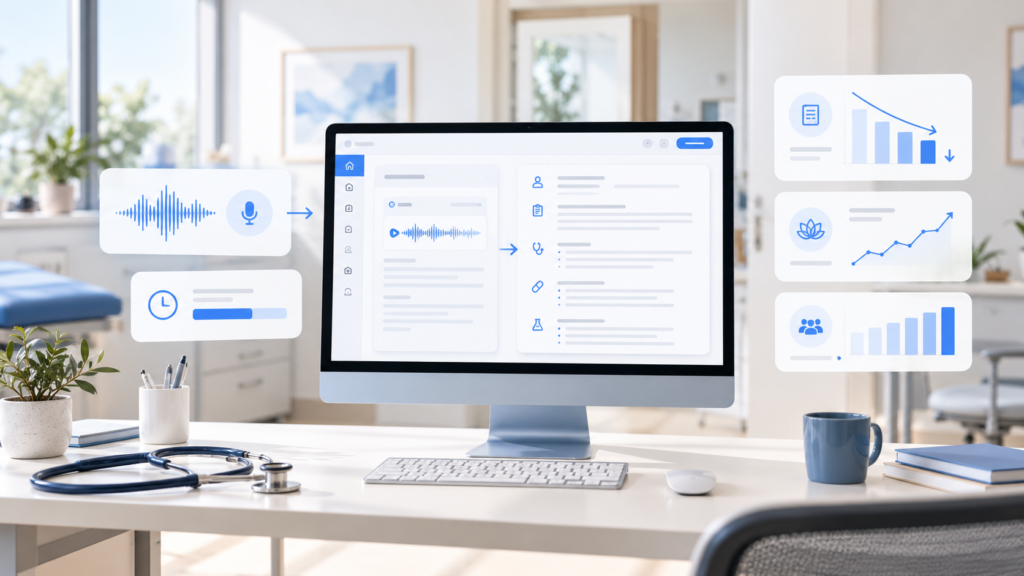
Ambient AI scribing is architecturally different from all previous approaches. It listens to a natural clinical conversation — without the clinician narrating to it, clicking through templates, or pausing to dictate — and generates a structured clinical note automatically.
The clinician talks to the patient. The AI takes the notes.
The specific changes this enables:
- Consultation time returns to the patient — no screen-facing, no typing mid-consultation
- Notes are drafted in real-time — ready for review and approval immediately after the encounter
- Pajama time is eliminated or dramatically reduced — end-of-day documentation catch-up disappears
- Cognitive load during consultations drops — the clinician can focus entirely on clinical reasoning
In early deployments, clinicians using ambient AI scribing report saving between 1.5 and 2.5 hours per day previously spent on documentation.
Across a GP practice of 5 physicians, that is potentially 7–12 hours of clinical capacity recovered every single day.
The Right Kind of Ambient AI: Why Architecture Matters

Not all ambient AI scribes are equal. For NHS practices and health systems in the UK, Australia, and Canada, where data is processed matters enormously.
Many ambient AI tools on the market are cloud-hosted — meaning patient consultation audio is transmitted to external servers, processed by third-party AI systems, and returned as a note. For organisations subject to NHS DSPT, UK GDPR, Australian Privacy Act, or Canadian PIPEDA requirements, this creates real compliance exposure.
On-premise ambient AI scribes — like KH Scribe — process everything locally. Patient audio never leaves the clinical environment. There are no external data flows, no third-party processors, no international transfer questions.
For NHS Trusts and GP federations in particular, this distinction is not a procurement preference. It is a data governance requirement.
What 3 Hours Returned Looks Like in Practice
If ambient AI documentation saves a physician 2 hours per day, what does that time become?
In a GP surgery: Two additional patient slots per clinician per day. In a 5-GP practice, that is 10 additional consultations daily — roughly 2,500 additional appointments per year. Against NHS waiting time targets, that is significant.
In a hospital ward: A registrar who finishes clerking notes an hour earlier is a registrar who can review more patients, respond to more bleeps, or — critically — go home on time. Rested clinicians make better decisions.
For the individual doctor: It is the difference between finishing at 6pm and finishing at 8pm. Between having dinner with family and missing it. Between a sustainable career and burning out by 45.
The productivity case for ambient AI documentation is strong. The human case is stronger.
Frequently Asked Questions
How many hours do doctors spend on clinical documentation each day? Research across the UK, US, Australia, and Canada consistently shows physicians spending 2–4 hours per day on clinical documentation and EHR tasks. For GPs in the NHS, this often amounts to 10–12 additional hours per week beyond patient-facing time.
What is “pajama time” in healthcare? “Pajama time” refers to the hours clinicians spend completing clinical notes and administrative tasks at home after their working day ends. It is a widely recognised symptom of documentation overload and a significant contributor to physician burnout and workforce attrition.
What is ambient AI clinical documentation? Ambient AI clinical documentation uses artificial intelligence to listen to a natural clinical conversation and automatically generate a structured clinical note — without the clinician needing to type, dictate, or navigate templates during the encounter. The clinician reviews and approves the note, but the drafting work is done by the AI.
How much time can ambient AI scribing save? Early deployments of ambient AI scribing tools report time savings of 1.5 to 2.5 hours per clinician per day previously spent on documentation. Individual results vary based on consultation volume, EHR complexity, and deployment configuration.
Is ambient AI documentation safe for patient data in the NHS? It depends on the architecture. Cloud-based ambient AI tools transmit patient audio to external servers, which creates UK GDPR and DSPT compliance complexity. On-premise ambient AI tools — like KH Scribe — process all data locally within the clinical environment, eliminating external data flows entirely.
Can ambient AI scribing help with physician burnout? Documentation burden is one of the most consistently cited drivers of physician burnout across all major healthcare systems. By removing the primary source of after-hours administrative work and reducing cognitive load during consultations, ambient AI scribing addresses one of the root causes — not just the symptoms — of clinician burnout.
Does ambient AI documentation affect consultation quality? Positively. Without the need to type or look at a screen during consultations, clinicians can maintain eye contact and focus fully on the patient. Studies show this improves patient experience scores and clinical interaction quality.
The Calculation Healthcare Systems Need to Make
Implementing ambient AI clinical documentation is a cost. But so is not implementing it.
The cost of physician burnout — in recruitment, retention, locum cover, training, and lost institutional knowledge — runs into hundreds of thousands of pounds per departing clinician. The cost of documentation-related consultation degradation is harder to quantify, but real.
Ambient AI scribing is not a technology luxury. It is a workforce investment with measurable returns — in clinician hours, in patient throughput, in retention, and in the quality of care delivered.
Three hours a day. Given back. What would your clinical team do with them?